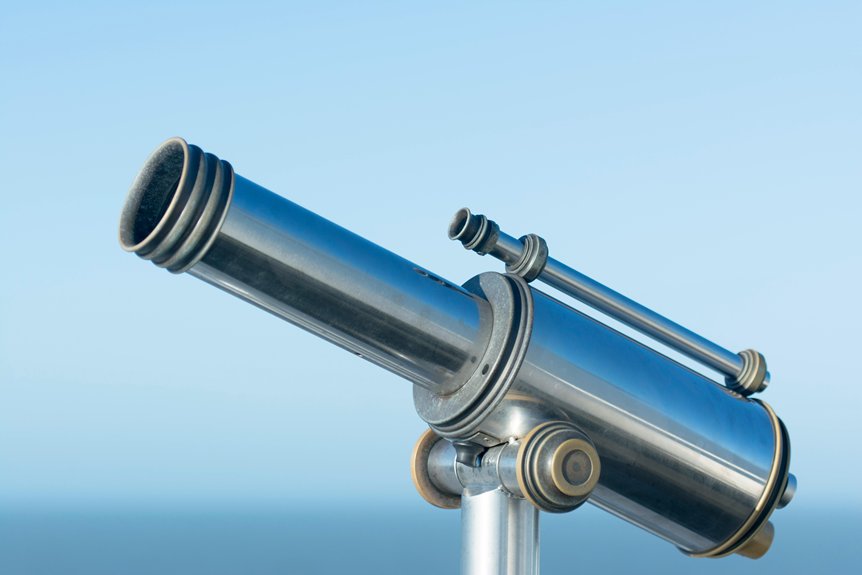
Did you know that the curvature of a telescope lens can greatly affect how it captures light? This design intricacy allows the lens to bend light rays, enhancing clarity and brightness for distant celestial views. Understanding this process is vital for appreciating the stunning images telescopes produce. But what happens when atmospheric conditions interfere with this delicate balance? Exploring these factors reveals more about the challenges telescopes face in their quest to reveal the cosmos.
The Basics of Telescopes: An Overview
When you look up at the night sky, a telescope can transform your curiosity into a close-up view of distant stars and planets. At its core, a telescope gathers and magnifies light, allowing you to explore the universe in stunning detail.
There are two main types: refractors and reflectors. Refractors use lenses to bend light, while reflectors utilize mirrors to capture it. Each design has its pros and cons, impacting clarity and ease of use.
Choosing the right telescope depends on your interests, whether you’re drawn to planetary observation or deep-sky exploration. With the right equipment, you won’t just see the cosmos—you’ll experience its wonders, igniting your passion for astronomy and innovation in understanding our universe.
How Light Travels Through Space
As you gaze into the vastness of space, it’s fascinating to realize that light travels at an astonishing speed of about 186,282 miles per second. This incredible velocity allows light from distant stars and galaxies to reach you, illuminating the universe’s wonders.
Once emitted, light moves in straight lines, creating paths that stretch across the cosmos. However, it can be influenced by gravity, bending around massive objects—a phenomenon known as gravitational lensing. This bending can reveal hidden celestial bodies, offering glimpses of the universe’s secrets.
Understanding how light travels through the void not only deepens your appreciation of the cosmos but also fuels innovations in technology, helping us explore and comprehend the universe like never before.
The Role of Lenses in Telescopes
Lenses play an essential role in telescopes, enabling you to magnify distant celestial objects and bring the wonders of the universe closer to your eyes. They work by bending light rays, allowing you to focus on intricate details of stars, planets, and galaxies.
The curvature and material of the lenses determine how effectively they gather and direct light. When you look through a telescope, these lenses transform your view, enhancing clarity and brightness.
As technology advances, innovative lens designs improve light gathering, reduce distortion, and enhance color accuracy. Whether you’re stargazing or studying the cosmos, understanding the function of lenses empowers you to appreciate the intricate mechanics behind telescope performance.
Get ready to explore the universe like never before!
Types of Telescopes: Reflecting vs. Refracting
Choosing the right telescope can greatly enhance your stargazing experience, and understanding the two main types—reflecting and refracting—will help you make an informed decision.
Reflecting telescopes use mirrors to gather and focus light, which allows for larger apertures without the weight of glass lenses. This design makes them great for deep-sky observations.
Reflecting telescopes, with their mirror design, enable larger apertures, making them ideal for exploring deep-sky wonders.
On the other hand, refracting telescopes utilize lenses to bend light and create images. They’re known for their crisp, high-contrast views, perfect for planetary observation.
Each type has its strengths, so consider your interests and preferences. Whether you’re drawn to the vastness of the cosmos or the beauty of celestial objects, selecting the right telescope can revolutionize your journey through the night sky.
The Importance of Aperture Size
Aperture size is one of the most critical factors to evaluate when selecting a telescope, and it can greatly impact your stargazing experience. The larger the aperture, the more light your telescope can gather, allowing you to see fainter stars and intricate details of celestial objects.
Imagine gazing at the rings of Saturn or the craters on the Moon with clarity that smaller apertures simply can’t provide. A bigger aperture also enhances image resolution, making your observations sharper and more defined.
While larger telescopes may be bulkier and pricier, the investment pays off in breathtaking views. So, when choosing a telescope, prioritize aperture size to reveal the universe’s wonders and elevate your astronomy adventures!
Focusing Light: The Mechanism Behind Telescopes
When you look through a telescope, you’re not just peering into the night sky; you’re harnessing the power of light to bring distant celestial objects into sharp focus.
Telescopes use lenses or mirrors to bend and reflect light, concentrating it at a specific point called the focal point. By adjusting the distance between the lens or mirror and the eyepiece, you can fine-tune the focus.
Each type of telescope—refractor or reflector—has its unique mechanism, yet they all share the same goal: clarity. This precision allows you to observe intricate details of galaxies, planets, and stars.
The Impact of Atmospheric Conditions on Viewing
As you gaze through your telescope, the clarity of your view can be dramatically altered by the atmospheric conditions above you. Factors like turbulence, humidity, and light pollution can distort the images you see. Understanding these elements helps you choose the best times for stargazing.
| Condition | Impact on Viewing | Best Practices |
|---|---|---|
| Turbulence | Blurry images | Observe on calm nights |
| Humidity | Hazy views | Wait for drier seasons |
| Light Pollution | Faded celestial objects | Find dark-sky locations |
| Temperature | Distortion from heat waves | Stargaze in cooler months |
| Wind | Shaking images | Use a windbreak if needed |
Digital Imaging and Telescopes: A Modern Approach
How can digital imaging transform your stargazing experience? With today’s technology, you can capture stunning images of celestial objects, turning your observations into lasting memories.
Digital cameras and sensors enhance light collection, allowing you to reveal details in the night sky that the naked eye misses.
Digital cameras and sensors unlock hidden details in the night sky, revealing wonders beyond the reach of the naked eye.
By using software, you can process and stack multiple images, reducing noise and improving clarity. It’s like having a personal astrophotographer at your fingertips!
You’ll enjoy real-time feedback, enabling you to adjust settings on the fly for the best results.
Plus, sharing your cosmic discoveries online becomes effortless. Embracing digital imaging elevates your passion for astronomy, making it more interactive and rewarding than ever before.
Get ready to explore the universe in ways you never thought possible!
Exploring Distant Galaxies: What Telescopes Reveal
Although the vastness of space can seem overwhelming, telescopes reveal the secrets of distant galaxies, revealing stunning details that spark your curiosity.
With each observation, you can explore swirling spirals, vibrant colors, and massive clusters, all light-years away. Telescopes, like the Hubble Space Telescope, capture light from these galaxies, translating it into breathtaking images and data.
You’ll witness phenomena like supernovae and the formation of new stars, giving you a glimpse into the universe’s past. These observations not only expand your understanding of cosmic evolution but also inspire you to ponder your place in the universe.
Future Innovations in Telescope Technology
With the wonders of distant galaxies revealed, the future of telescope technology promises even more extraordinary discoveries.
Imagine telescopes equipped with adaptive optics that can instantly adjust to atmospheric disturbances, providing stunning, crystal-clear images.
You’ll also see advancements in space-based telescopes, minimizing light pollution and offering deeper views into the universe.
AI and machine learning are set to revolutionize data analysis, allowing you to uncover patterns in vast cosmic datasets faster than ever.
Additionally, innovations in materials will lead to lighter, more efficient designs that enhance portability and accessibility.
Get ready for a new era where citizen scientists can contribute to groundbreaking research, making the cosmos more accessible for everyone.
The sky truly isn’t the limit!
About the Author