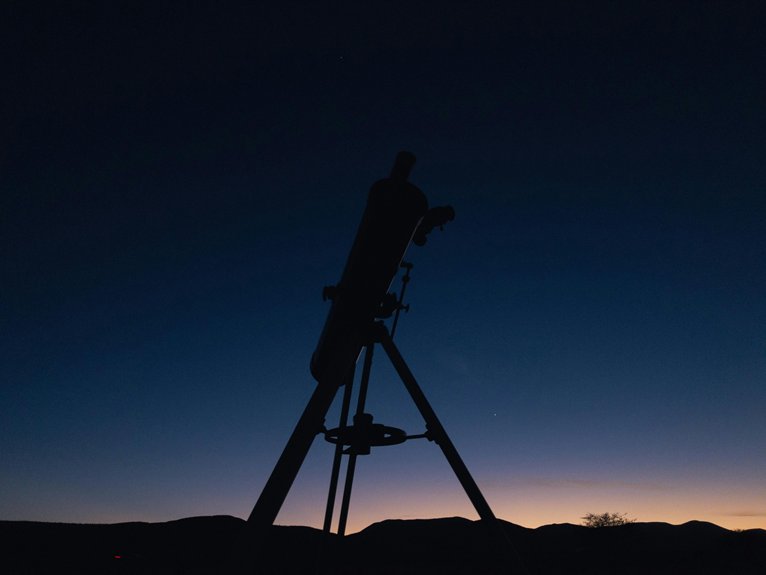
You might be surprised to learn that the first telescope was invented in the early 17th century, with Hans Lippershey often credited for it in 1608. This invention didn’t just magnify distant objects; it changed humanity’s perception of the universe. As you explore the story of this revolutionary tool, you’ll uncover how it empowered astronomers like Galileo to challenge established beliefs and make groundbreaking discoveries. What did they find that shifted our understanding forever?
The Origins of the Telescope
While you might think of telescopes as modern inventions, their origins trace back to the early 17th century in Europe. Imagine a time when scientists began experimenting with lenses to magnify distant objects.
This spark of curiosity led to groundbreaking discoveries that changed humanity’s view of the cosmos. You’d find that these early pioneers, like Hans Lippershey, crafted devices that could bring celestial bodies closer, igniting a passion for exploration.
The simple act of combining lenses set the stage for a revolution in astronomy. As you explore this history, you’ll appreciate how these innovations paved the way for advanced technology, ultimately transforming our understanding of the universe and inspiring generations of astronomers and dreamers alike.
Early Designs and Innovations
The early designs of telescopes laid the groundwork for astronomical advancements that followed. You can see how these innovative concepts evolved through simple yet effective approaches.
| Design Element | Description |
|---|---|
| Lenses | Crafted from glass, these focused light to magnify distant objects. |
| Tube Structure | A cylindrical design guaranteed stability and improved viewing clarity. |
| Mounting Techniques | Early mounts allowed for easier aiming at celestial bodies. |
| Optical Innovations | Improvements in lens curvature enhanced image quality. |
These initial innovations sparked a revolution in astronomy, enabling thinkers to gaze deeper into the cosmos. As you explore these early designs, consider how they paved the way for future breakthroughs that transformed our understanding of the universe.
The Role of Galileo Galilei
As Galileo Galilei turned his gaze toward the heavens in the early 17th century, he transformed the way we comprehend our universe. By improving the telescope design, he didn’t just enhance its magnification; he opened a new chapter in astronomy.
You’ll marvel at how he discovered Jupiter’s moons, revealing celestial bodies orbiting something other than Earth. This challenged long-held beliefs and ignited a scientific revolution.
Galileo’s meticulous observations of the lunar surface, sunspots, and the phases of Venus showcased the universe’s complexity and dynamism. He didn’t shy away from sharing his findings, making science accessible.
His relentless curiosity and innovative spirit continue to inspire generations, reminding us that looking up can lead to groundbreaking discoveries.
The Advancements of the 17th Century
Amidst the fervor of scientific inquiry in the 17th century, innovations in telescope technology sparked a revolution in our understanding of the cosmos.
You’re witnessing a thrilling era where the boundaries of exploration expanded dramatically.
The advancements during this time include:
The era witnessed remarkable advancements, refining lenses and innovating telescope designs that reshaped our cosmic perspective.
- Improved Lenses: Makers refined glass quality, enhancing clarity and magnification.
- Reflecting Telescopes: Newton introduced designs that minimized chromatic aberration, providing sharper images.
- Standardization of Instruments: Opticians began creating telescopes with consistent specifications, making them more accessible to astronomers.
These developments didn’t just improve views of celestial bodies; they transformed how you perceive the universe.
As a result, humanity took its first steps into a broader cosmic understanding, laying the groundwork for future astronomical discoveries.
The Impact on Astronomy
While exploring the cosmos through early telescopes, you experience a profound shift in astronomy that reshapes human understanding of the universe. These groundbreaking instruments open up new vistas, revealing celestial bodies and phenomena previously hidden from view. With each observation, you uncover the intricacies of our solar system and beyond.
| Impact | Description |
|---|---|
| Improved Accuracy | Telescopes enhanced observational precision. |
| New Discoveries | You identify planets and moons, changing perceptions. |
| Challenge to Beliefs | Astronomy shifts from geocentric to heliocentric views. |
| Scientific Collaboration | Encourages teamwork among astronomers across Europe. |
These advancements ignite curiosity, fostering a deeper connection to the cosmos and inspiring generations of thinkers. You’ve stepped into an era of discovery that transforms humanity’s place in the universe.
The Evolution of Telescope Technology
The early telescopes that transformed our understanding of the universe laid the groundwork for ongoing innovations in telescope technology. From those humble beginnings, advancements have rapidly evolved, pushing the boundaries of what you can observe in the cosmos.
- Improved lens quality enhanced clarity and brightness.
- Mounting systems evolved, allowing for precision tracking of celestial objects.
- Digital imaging revolutionized data collection, enabling deeper analysis.
These developments not only improved your viewing experience but also expanded the horizon of astronomical research.
As you explore the night sky, remember that each leap in technology brings you closer to unraveling the universe’s mysteries. Embracing these innovations will continue to shape the future of astronomy, inspiring you to reach for the stars.
Modern Telescopes and Their Capabilities
As you gaze through a modern telescope, you’ll quickly realize how far we’ve come in our quest to understand the cosmos.
Today’s telescopes, equipped with advanced optics and cutting-edge technology, allow you to explore the universe like never before. With capabilities like adaptive optics, they can correct atmospheric distortions, delivering crystal-clear images of distant galaxies and nebulae.
High-resolution imaging and spectrographs enable you to analyze the composition of stars and planets, revealing their secrets.
Furthermore, space-based telescopes like Hubble and James Webb free you from the constraints of Earth’s atmosphere, uncovering the universe’s hidden wonders.
Whether you’re a seasoned astronomer or a curious novice, modern telescopes invite you to begin an exhilarating journey through space and time.
The Lasting Legacy of the Telescope
Though often overlooked, the telescope’s influence stretches far beyond its glass lenses.
It revolutionized our understanding of the universe and sparked a wave of innovation that continues today. You can appreciate its legacy in various ways:
- Scientific Advancements: Telescopes have led to groundbreaking discoveries, from the moons of Jupiter to the expansion of the universe.
- Technological Innovation: The engineering behind telescopes has inspired developments in optics, imaging, and materials science.
- Cultural Impact: As symbols of exploration, telescopes have fueled our imagination and drive to explore the unknown.
Every time you gaze at the night sky, remember that the telescope opened the doorway to the cosmos, forever changing the way humanity perceives its place in the universe.
About the Author


