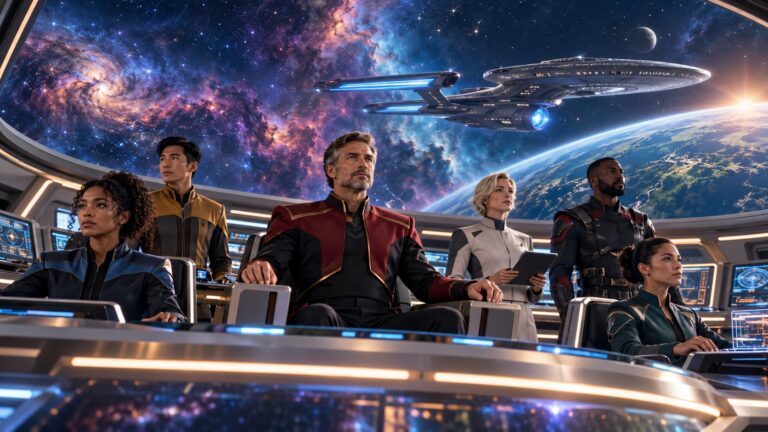
Star Trek turns 60 on September 8, 2026. That is six decades of captains making impossible calls, starships crossing unmapped space, and enemies becoming allies over a conference table.
The franchise began on September 8, 1966, when “The Man Trap” became the first episode of Star Trek: The Original Series broadcast in the United States. Its future was not built in one straight line. It grew through television, films, animation, alternate timelines, political crises, strange new worlds and hundreds of characters.
This guide connects those pieces. It explains the Star Trek timeline, the major series, Starfleet, the USS Enterprise lineage, key species such as the Klingons, Romulans, Gorn and Borg, and the characters who shaped the Federation. It also separates on-screen canon from books, fan theories and wiki shorthand.
New viewers can use it as a map. Long-time fans can use it as a quick reference.
What Is Star Trek?
Star Trek is a science-fiction franchise about humanity’s future among the stars. Most stories follow Starfleet officers as they explore space, make first contact with alien civilizations, defend the United Federation of Planets and confront the consequences of their own ideals.
Its central idea is optimistic but never simple. Humanity has largely overcome poverty, hunger and internal war on Earth. The harder question is what people do with that progress when they meet cultures with different values, encounter technology they do not understand or gain power they may not be ready to use.
| Quick fact | Answer |
|---|---|
| Creator | Gene Roddenberry |
| First broadcast | September 8, 1966 |
| Original starship | USS Enterprise, NCC-1701 |
| Core organization | Starfleet |
| Political home | United Federation of Planets |
| First television captain seen by viewers | Captain James T. Kirk |
| Earliest lead captain in the main chronology | Captain Jonathan Archer |
| Main continuity | The Prime Timeline |
| Major alternate continuity | The Kelvin Timeline |
| Guiding mission | Explore, make peaceful contact and expand knowledge |
The famous opening promise to explore “strange new worlds” describes only part of the franchise. Star Trek also asks who deserves rights, when rules should be broken, whether an enemy can change and how a society survives its own fear.
Every Star Trek Series and Era at a Glance
The easiest way to understand Star Trek is to separate release order from story chronology. Release order shows how the franchise developed. Timeline order follows events inside its fictional history.
| Series | Original debut | Main era | Best known for |
|---|---|---|---|
| Star Trek: The Original Series | 1966 | 23rd century | Kirk, Spock, Uhura and the original Enterprise |
| Star Trek: The Animated Series | 1973 | 23rd century | Continuing the original five-year mission in animation |
| Star Trek: The Next Generation | 1987 | 24th century | Jean-Luc Picard, Data and the Enterprise-D |
| Star Trek: Deep Space Nine | 1993 | 24th century | Benjamin Sisko, Bajor and the Dominion War |
| Star Trek: Voyager | 1995 | 24th century | Captain Janeway’s journey home from the Delta Quadrant |
| Star Trek: Enterprise | 2001 | 22nd century | Jonathan Archer, the NX-01 and the road to the Federation |
| Star Trek: Discovery | 2017 | 23rd and 32nd centuries | Michael Burnham, the spore drive and a far-future Federation |
| Star Trek: Picard | 2020 | Turn of the 25th century | Picard’s later life and the next Enterprise crew |
| Star Trek: Lower Decks | 2020 | 24th century | Junior officers, deep lore and animated comedy |
| Star Trek: Prodigy | 2021 | 24th century | Young outsiders learning Starfleet values |
| Star Trek: Strange New Worlds | 2022 | 23rd century | Captain Pike’s Enterprise before Kirk’s command |
| Star Trek: Starfleet Academy | 2026 | 32nd century | Cadets rebuilding the institution after Discovery |
The official Star Trek series and movies directory is the cleanest current list of screen productions. It includes the feature films and streaming movies as well as the television shows.
The films in one minute
The first six films continue the original crew’s story. Star Trek Generations passes the cinematic baton from Kirk to Picard. The next three films center on the TNG crew, including Star Trek: First Contact, the defining Borg movie.
The 2009 film then created the Kelvin Timeline. Star Trek Into Darkness and Star Trek Beyond continue that branch. The streaming film Star Trek: Section 31 returns to the Prime Timeline and explores the Federation’s covert operations.
The Star Trek Timeline Order Explained
There is no single perfect viewing order. Release order preserves surprises and changing production styles. Chronological order makes the political and technological development easier to follow.
For a first watch, release order is usually smoother. For a rewatch, timeline order reveals long-running connections.
Prime Timeline in chronological order
| Approximate period | Series or films | What changes |
|---|---|---|
| 2151 onward | Enterprise | The NX-01 makes early deep-space contacts before the Federation exists |
| 2250s | Discovery, Seasons 1–2 | The Klingon War, the spore drive and the mystery of the Red Angel |
| 2259 onward | Strange New Worlds | Christopher Pike commands the Enterprise with Spock and Una |
| 2265–2269 | The Original Series | James Kirk leads the famous five-year mission |
| Late 2260s | The Animated Series | The original crew’s mission continues |
| 2270s–2293 | Original-cast films | V’Ger, Khan, the Genesis crisis and peace with the Klingons |
| Early 24th century | Section 31 | Philippa Georgiou operates in the dangerous space between law and secrecy |
| 2364–2370 | The Next Generation | Picard’s Enterprise-D explores during a changing Federation era |
| 2369–2375 | Deep Space Nine | Bajor, the wormhole and the Dominion War reshape the Alpha Quadrant |
| 2371–2378 | Voyager | The USS Voyager crosses the Delta Quadrant |
| 2370s–2380s | TNG films, Lower Decks, Prodigy | First Contact, the Romulan crisis and Starfleet’s next generation |
| 2399–2401 | Picard | Jean-Luc Picard confronts old choices, new synth life and a Borg plot |
| 3188 onward | Discovery, Seasons 3–5 | The crew helps reconnect a fractured far-future Federation |
| 32nd century | Starfleet Academy | A new class trains after the Academy reopens |
Star Trek dates sometimes look tidier in a chart than they feel on screen. Time travel, classified missions and overlapping shows create exceptions. The official chronological Star Trek viewing guide is useful when a precise episode-level watch is the goal.
The Kelvin Timeline and Star Trek 2009
The Kelvin Timeline begins when the Romulan mining ship Narada travels into the past and attacks the USS Kelvin in 2233. George Kirk dies saving the ship’s survivors, including his newborn son, James Kirk. That event changes the future.
The characters are familiar, but their lives unfold differently:
- James Kirk reaches the captain’s chair by another route.
- Spock loses Vulcan and struggles with grief on a planetary scale.
- Nyota Uhura serves aboard the Enterprise and has a different relationship with Spock.
- Khan Noonien Singh returns in Into Darkness.
- Carol Marcus helps expose Admiral Marcus and the enormous USS Vengeance.
- Beyond reveals the lost USS Franklin and its former captain, Balthazar Edison, later known as Krall.
The Kelvin films do not erase the original history. Both timelines exist within Star Trek’s multiverse.
Where does Star Trek: Destiny fit?
Star Trek: Destiny is an acclaimed novel trilogy by David Mack. It presents a vast Borg conflict involving crews from several 24th-century book series. It is not part of the current on-screen canon, so it does not determine what happens in Picard or other television productions.
That distinction matters. Star Trek novels can tell ambitious stories, but later screen productions are not required to follow them.
The Captains and Crews Who Define Star Trek
Star Trek changes when its captain changes. Kirk is decisive and improvisational. Picard leads through diplomacy and moral reasoning. Sisko becomes a wartime commander and religious figure. Janeway has to preserve Starfleet values far from Starfleet support.
Christopher Pike and the Strange New Worlds crew
Captain Christopher Pike commanded the USS Enterprise before James Kirk. Strange New Worlds turns him into the center of an ensemble that knows the future can be frightening without treating it as fixed.
| Character | Role or connection |
|---|---|
| Christopher Pike | Captain of the Enterprise and predecessor to Kirk |
| Spock | Vulcan science officer balancing logic, duty and human emotion |
| Una Chin-Riley | First officer, also known as Number One; secretly Illyrian |
| La’an Noonien-Singh | Security chief and descendant of Khan Noonien Singh |
| Joseph M’Benga | Chief medical officer, played by Babs Olusanmokun |
| Christine Chapel | Nurse and later doctor, played by Jess Bush |
| Nyota Uhura | Gifted linguist growing into the officer known from TOS |
| Sam Kirk | George Samuel Kirk, James Kirk’s brother and a xenobiologist |
| T’Pring | Spock’s Vulcan fiancée and a specialist in rehabilitation |
Una Chin-Riley’s genetic status drives one of the show’s clearest legal stories. La’an Noonien-Singh carries the stigma of the Noonien-Singh name without sharing Khan’s crimes. Babs Olusanmokun gives M’Benga a quiet intensity, while Jess Bush brings new depth to Chapel’s ambitions and her bond with Spock.
The series also revisits the Gorn, Rigel VII and the complicated Kirk family. George Kirk is the father of James and Sam, while Sam serves with Pike years before his brother takes command.
Captain Kirk, Spock and the original crew
Captain James T. Kirk is the franchise’s original television lead. He relies on Spock’s logic, Dr. Leonard McCoy’s humanity and his own ability to act before a crisis closes every option.
The bridge crew became a cultural template:
- Nyota Uhura handles communications and repeatedly demonstrates command ability.
- Montgomery “Scotty” Scott keeps the starship Enterprise alive under impossible conditions.
- Pavel Chekov joins as a young navigator and later serves as tactical officer.
- Hikaru Sulu moves from helm officer to captain of the USS Excelsior.
- Spock becomes one of Star Trek’s clearest expressions of divided identity.
Kirk’s most famous enemy is Khan Noonien Singh, a genetically engineered survivor of Earth’s Eugenics Wars. Their conflict begins in “Space Seed” and reaches its tragic peak in Star Trek II: The Wrath of Khan.
Jean-Luc Picard and The Next Generation
Jean-Luc Picard commands the Enterprise-D as an explorer, diplomat and scholar. His authority is quiet until a situation demands steel.
His senior officers each open a different part of the universe:
- William Riker is the trusted first officer. His transporter duplicate, Thomas Riker, later follows a separate and troubled path.
- Data is an android trying to understand humanity without pretending he is human.
- Geordi La Forge is the chief engineer whose technical imagination saves the ship repeatedly.
- Worf is a Klingon raised by humans, caught between cultures and eventually central to Klingon politics.
- Deanna Troi is a Betazoid-human counselor whose empathic insight shapes command decisions.
- Tasha Yar is the Enterprise-D’s first security chief. Her death at the hands of Armus has consequences across alternate timelines.
- Guinan is an El-Aurian listener with unusual knowledge of time, the Borg and Q.
- Ensign Ro Laren is a Bajoran officer whose conflict with Starfleet anticipates many of Deep Space Nine’s concerns.
Picard’s adventures range from the courtroom logic of Q to the fragmented language of “Darmok.” His detective alter ego Dixon Hill gives him an escape into holodeck noir. His assimilation as Locutus of Borg leaves damage that neither rescue nor revenge can instantly repair.
For a deeper crew and episode breakdown, read our complete guide to Star Trek: The Next Generation.
Benjamin Sisko and Deep Space Nine
Benjamin Sisko begins as the commander of a damaged station near Bajor. He becomes the Emissary to the Bajoran Prophets, captain of the USS Defiant and one of the Federation’s most important leaders during the Dominion War.
Kira Nerys brings the perspective of a former resistance fighter. Jadzia Dax carries the memories of multiple Trill lifetimes. Julian Bashir grows from an overconfident young doctor into a tested intelligence operative. Quark turns Ferengi commerce into comedy, leverage and, occasionally, courage. Jake Sisko provides a civilian view of war and of life with a celebrated father.
The station’s food, money and customs feel lived in. Characters eat hasperat, bargain in gold-pressed latinum and cite the Rules of Acquisition. The Grand Nagus can influence Ferengi society as strongly as a head of state. Miles and Keiko O’Brien raise Molly O’Brien on the station, so viewers also see how a Starfleet family experiences its dangers and ordinary routines.
Our Star Trek: Deep Space Nine guide follows the station, wormhole, Bajor and Dominion War in greater detail.
Kathryn Janeway, Seven of Nine and Voyager
Captain Kathryn Janeway must bring the USS Voyager home from the Delta Quadrant, roughly 70,000 light-years from Federation space. Her crew combines Starfleet officers, former Maquis rebels and people they meet along the way.
Tom Paris becomes Voyager’s pilot and helps design the Delta Flyer. Neelix serves as local guide, cook and morale officer. Kes develops powerful mental abilities before leaving the ship. Naomi Wildman grows up aboard Voyager and gives its isolated community a sense of future.
Seven of Nine, often shortened by fans to 7 of 9, is a former Borg drone reclaiming her individuality. Her arguments with Janeway make both characters stronger. “Tuvix,” meanwhile, remains one of Star Trek: Voyager’s sharpest ethical disputes because the transporter-created individual can survive only if Tuvok and Neelix remain merged.
Voyager’s Delta Quadrant threats include the organ-harvesting Vidiians, hunting-obsessed Hirogen, the Borg and Species 8472. The USS Prometheus also appears in one of the crew’s crucial attempts to contact home.
Jonathan Archer, T’Pol and the NX-01
Jonathan Archer captains Earth’s first Warp 5 starship, Enterprise NX-01. He explores before Starfleet has mature first-contact rules or a Federation to provide political cover.
T’Pol begins as a Vulcan observer and becomes one of Archer’s most trusted officers. Their crew encounters Andorians, Tellarites, Klingons, Tholians and the Xindi. Agent Daniels repeatedly pulls Archer into the Temporal Cold War, revealing futures the NX-01 crew is helping create.
Discovery, Lower Decks and Prodigy crews
Star Trek: Discovery follows Michael Burnham from mutineer to captain. Saru, the first Kelpien in Starfleet, grows from a fear-conditioned officer into a confident leader and diplomat. Adira Tal, played by Blu del Barrio, brings a new human host into the long history of the Trill symbiont Tal.
Lower Decks focuses on the junior officers of the USS Cerritos. Beckett Mariner resists conventional advancement even while proving how capable she is. Brad Boimler wants the rule book to become a career ladder. Badgey, a seemingly cheerful training hologram, becomes dangerously unstable. Moopsy looks harmless and cute until its feeding habits become clear.
Star Trek: Prodigy begins with young characters who do not belong to Starfleet. Through the USS Protostar and a holographic Janeway, they learn what the organization is supposed to represent.
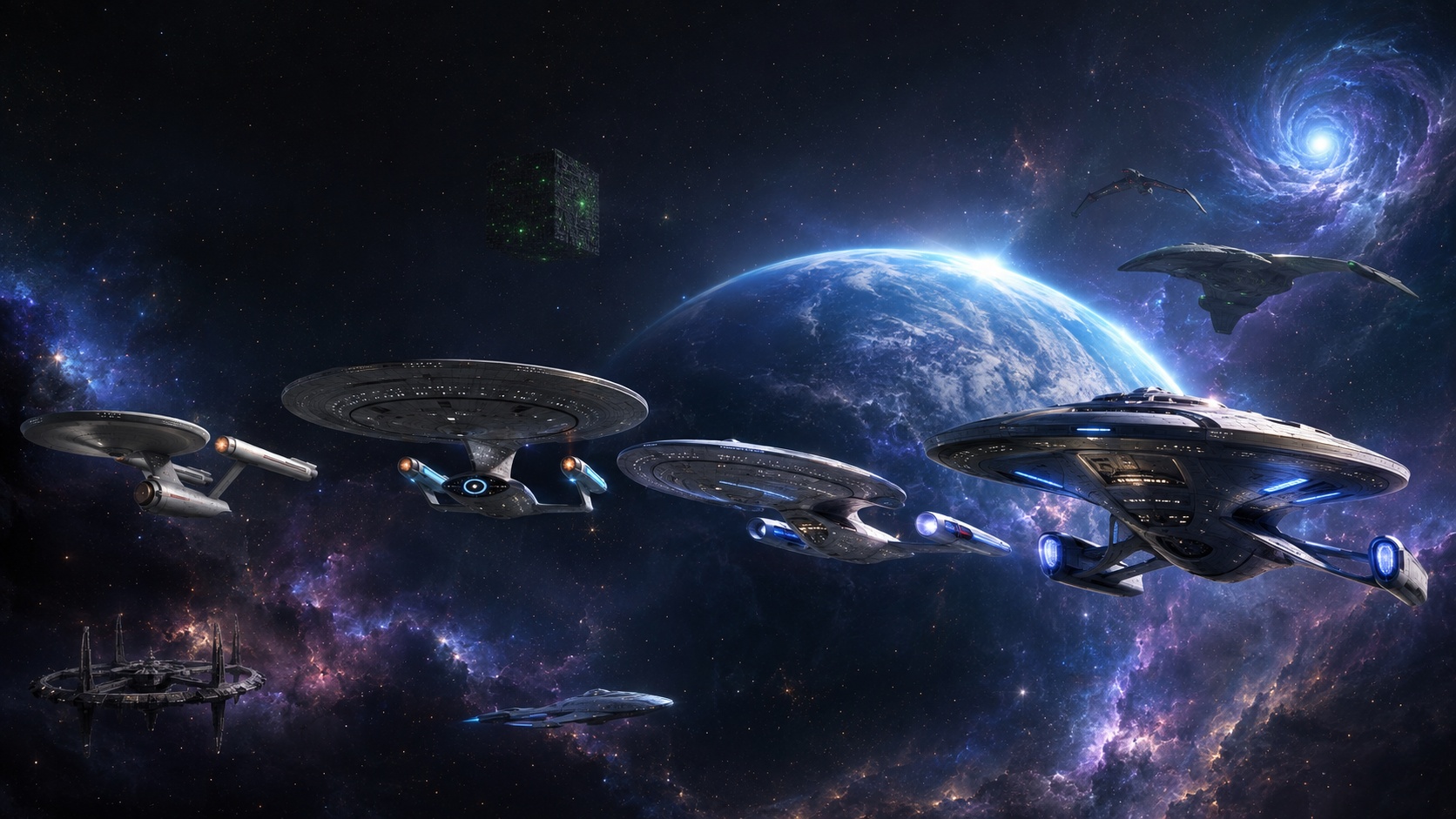
Every USS Enterprise from NX-01 to Enterprise-G
“Enterprise” is not one ship. It is a legacy passed from crew to crew, with each vessel reflecting its era’s ambitions and dangers.
| Ship | Registry or class | Why it matters |
|---|---|---|
| Enterprise NX-01 | NX class | Earth’s first Warp 5 exploration ship under Jonathan Archer |
| USS Enterprise | NCC-1701, Constitution class | Pike’s and Kirk’s original starship |
| USS Enterprise-A | NCC-1701-A, Constitution-class refit | Kirk’s later command after the original ship’s destruction |
| USS Enterprise-B | NCC-1701-B, Excelsior class | Launch ship in Generations; Kirk vanishes during its rescue mission |
| USS Enterprise-C | NCC-1701-C, Ambassador class | Sacrifices itself defending a Klingon outpost at Narendra III |
| USS Enterprise-D | NCC-1701-D, Galaxy class | Picard’s vast exploration flagship in The Next Generation |
| USS Enterprise-E | NCC-1701-E, Sovereign class | Fights the Borg in First Contact and serves through the TNG films |
| USS Enterprise-F | NCC-1701-F, Odyssey class | Appears during Frontier Day before retirement |
| USS Enterprise-G | NCC-1701-G, Constitution III class | The renamed Titan-A, commanded by Captain Seven of Nine |
| Enterprise-J | Universe class | A possible 26th-century ship seen during the Temporal Cold War |
The registry NCC-1701 carries the family identity. The suffix changes when Starfleet commissions a successor. That is why both “NCC 1701” and “NCC-1701” usually point to the original Enterprise and its lineage.
The Enterprise-C has limited screen time, yet its sacrifice helps secure peace between the Federation and Klingon Empire. The Enterprise-D represents the scale and confidence of the 24th-century Federation. The Enterprise-E is built for a more dangerous era. The Enterprise-F and Enterprise-G then connect the legacy to the opening decades of the 25th century.
The Enterprise-J is different. It appears as part of a possible future, so later events could still alter the path leading to it.
Other Starships Every Fan Should Know
The Enterprise is the flagship name, but Star Trek’s universe depends on many other vessels.
| Starship | Class or origin | Defining connection |
|---|---|---|
| USS Voyager | Intrepid class | Stranded in the Delta Quadrant under Captain Janeway |
| Delta Flyer | Custom shuttlecraft | Designed by Voyager’s crew for extreme missions |
| USS Defiant | Defiant class | Compact warship assigned to Deep Space 9 |
| USS Excelsior | Excelsior class | Experimental transwarp vessel later commanded by Sulu |
| USS Prometheus | Prometheus class | Advanced ship capable of multi-vector assault mode |
| USS Stargazer | Constellation class | Picard’s first command before the Enterprise-D |
| USS Stargazer | Sagan class | 25th-century ship central to Picard Season 2 |
| USS Kelvin | Kelvin type | Its destruction creates the Kelvin Timeline |
| USS Vengeance | Dreadnought class | Section 31 warship built in secret in Into Darkness |
| USS Franklin | Freedom class | Early Earth ship discovered in Star Trek Beyond |
| Klingon Bird-of-Prey | Several related classes | Agile warship with cloaking capability |
| Romulan Bird-of-Prey | Romulan design lineage | A symbol of Romulan secrecy and military power |
| Borg cube | Borg vessel | Enormous decentralized ship built for assimilation and endurance |
The Excelsior class becomes one of Starfleet’s longest-serving designs. The Galaxy-class starship represents exploration on a city-like scale. The smaller Defiant is almost the opposite: heavily armed, compact and created in response to the Borg threat.
Starfleet, Its Ranks and Its Technology
Starfleet is the Federation’s exploratory, scientific, diplomatic and defensive service. It is not simply a navy in space. Its officers chart anomalies, negotiate treaties, study new life, perform disaster relief and defend member worlds.
Starfleet ranks in simple order
Exact insignia and uniform designs change by era, but the common officer path is:
- Ensign
- Lieutenant junior grade
- Lieutenant
- Lieutenant commander
- Commander
- Captain
- Rear admiral and higher flag ranks
Cadets train at Starfleet Academy before receiving a commission. Not every captain commands a ship, and a ship’s commanding officer does not always hold the formal rank of captain. Starfleet also has enlisted personnel and specialist roles that do not fit neatly into a bridge-command ladder.
Starfleet uniforms communicate department, rank and historical period. The colors are not consistent across every century. In the TOS era, gold commonly marks command. By the TNG era, command uses red while operations moves to gold.
The technology that makes the setting work
| Technology | Function | Story consequence |
|---|---|---|
| Warp drive | Bends spacetime to permit faster-than-light travel | Makes interstellar exploration practical |
| Transporter | Converts and transmits matter through a matter stream | Enables rapid travel and creates identity puzzles such as Tuvix and Thomas Riker |
| Phaser | Adjustable directed-energy tool and weapon | Can stun, heat, cut or destroy depending on setting |
| Universal translator | Interprets languages in real time | Makes first contact possible while leaving room for failures such as “Darmok” |
| Replicator | Converts energy into food and objects | Helps create a post-scarcity Federation economy |
| Holodeck | Builds interactive simulated environments | Supports training, therapy, entertainment and frequent emergencies |
| Cloaking device | Conceals a ship from ordinary sensors | Shapes Klingon and Romulan tactics |
| Transwarp | Travel beyond standard warp limitations | Gives the Borg a strategic advantage through conduit networks |
Star Trek phasers are tools before they are firearms. “Set phasers to stun” expresses the preference to preserve life when possible. For a real-world technology with an unmistakably Trek-like profile, see our look at the PepperBall mobile launcher and the phaser comparison.
Self-sealing stem bolts sit at the other end of the technology spectrum. Nobody clearly explains what they do. That vagueness made them a perfect recurring trade good and one of Deep Space Nine’s most durable jokes.
The Major Species and Powers of Star Trek
Star Trek’s alien civilizations are not fixed personality types. The strongest stories question the stereotypes that Starfleet officers and viewers bring with them.
Vulcans and IDIC
Vulcans organize their lives around logic and emotional discipline after nearly destroying themselves through war. Spock and T’Pol reveal that control is an active practice, not an absence of feeling.
IDIC means “Infinite Diversity in Infinite Combinations.” It is both a Vulcan philosophy and a concise statement of Star Trek’s pluralism. Amanda Grayson, Spock’s human mother, helps him understand that his two heritages need not cancel each other out.
Klingons, honor and political power
Klingons begin as Cold War adversaries and develop into one of the franchise’s most detailed cultures. Honor is central, but characters constantly argue about what honorable conduct actually requires.
Worf experiences the gap between idealized Klingon tradition and Klingon politics. Gowron rises to chancellor, while Kor represents an older warrior tradition that stretches back to Kirk’s era. Bat’leths, mek’leths and disruptors are recognizable Klingon weapons, but political legitimacy often matters more than firepower.
The Klingon Bird-of-Prey is compact, dangerous and capable of cloaking. One captured vessel even carries Kirk’s crew through time in The Voyage Home.
Romulans, Remans and the price of secrecy
Romulans share ancient ancestry with Vulcans but built an empire around secrecy, hierarchy and strategic control. The Romulan Star Empire repeatedly uses espionage and misdirection as weapons.
Romulan ships include several designs called Birds-of-Prey as well as the huge D’deridex-class warbird. Romulan ale is a potent blue drink that the Federation periodically bans, which rarely stops Starfleet officers from finding it.
Remus is the neighboring world of Romulus and home to the Remans. Nemesis brings their exploitation into the open through Shinzon’s revolt. The destruction of Romulus later becomes a defining political wound in Star Trek: Picard and the Kelvin films.
The Borg, the Borg Queen and Locutus
The Borg are a cybernetic collective that absorbs people, knowledge and technology through assimilation. A Borg cube does not need the sleek lines of a Starfleet vessel. Its brutal geometry reflects redundancy, scale and collective function.
The Borg Queen gives the Collective a personal voice, but she is not simply a conventional monarch commanding separate subjects. She presents herself as the intelligence that brings order to the many.
At Wolf 359, a single cube destroys 39 Federation ships after assimilating Jean-Luc Picard as Locutus of Borg. Star Trek: First Contact then takes the Enterprise-E into the past as the Borg try to prevent humanity’s first warp flight and its first contact with Vulcans.
Seven of Nine shows that a drone can recover individuality. Species 8472 proves that even the Borg can encounter a species they cannot readily assimilate or defeat. Voyager’s temporary alliance with the Collective forces Janeway to choose between two existential threats.
For the full history, hierarchy and technology of the Collective, read our guide to the Borg in Star Trek.
The Gorn
The Gorn first appear in “Arena,” where Kirk fights a Gorn captain on a barren world. The episode looks like a monster battle, but its resolution rejects simple revenge.
Strange New Worlds reimagines the Gorn as a terrifying, poorly understood threat. La’an’s history with them makes every encounter personal. These newer stories expand Gorn biology and behavior, though the full relationship between different depictions remains deliberately unsettled.
Andorians, Tellarites and the birth of the Federation
Andorians are blue-skinned people with antennae, strong military traditions and a long rivalry with Vulcan. Commander Shran, played by Jeffrey Combs, turns that rivalry into one of Enterprise’s richest alliances.
Tellarites are argumentative by cultural convention. What humans may hear as rudeness can function as honest engagement. Humans, Vulcans, Andorians and Tellarites become the founding core of the Federation.
Betazoids, Orions and other Federation neighbors
Betazoids are telepathic, though individual abilities vary. Deanna Troi is half Betazoid and primarily empathic. The Betazoid word imzadi describes a deeply beloved person and defines her enduring connection with Riker.
Orions were once framed mainly through piracy and the “Orion slave girl” stereotype. Later Star Trek gives Orion characters agency, occupations and conflicting social identities. Tendi in Lower Decks is a scientist whose family history connects her to Orion power structures without defining her entire future.
Tribbles, Moopsy and deceptively cute creatures
Tribbles are small, furry animals that reproduce at an extraordinary rate. In “The Trouble with Tribbles,” their appetite and biology turn a seemingly harmless pet into an ecological and logistical crisis. Klingons despise them, and tribbles react just as strongly to Klingons.
Moopsy, introduced in Lower Decks, uses the same visual trick with a darker punchline. It looks like a soft museum animal but drinks the bones of living victims. Both creatures work because Star Trek lets cuteness conceal a genuine threat.
The Dominion, Jem’Hadar and the Breen
The Dominion rules much of the Gamma Quadrant through fear, diplomacy and engineered dependency. Its Founders are shapeshifters. The Vorta administer policy, while Jem’Hadar soldiers enforce it.
Jem’Hadar are genetically dependent on ketracel-white, a drug controlled by the Vorta. That dependence makes rebellion difficult and turns logistics into a method of rule.
The Dominion War draws the Federation, Klingons and Romulans into a costly alliance. The Breen Confederacy later joins the Dominion and delivers a devastating attack on Earth. The war tests whether Federation principles can survive when survival itself is uncertain.
Hirogen, Tholians, Tzenkethi and Lanthanites
The Hirogen are nomadic Delta Quadrant hunters who treat other beings as prey and trophies. The Tholians are crystalline beings whose territorial caution and web technology make them dangerous across multiple eras.
The Tzenkethi are discussed more often than seen. Their border conflicts with the Federation influence events in Deep Space Nine, making them a useful reminder that major powers exist beyond the cultures most often shown.
Lanthanites look human but can live for thousands of years. Pelia, introduced in Strange New Worlds, is a Lanthanite engineer whose long memory reaches back through centuries of Earth history.
Q, Trelane and beings beyond ordinary physics
Q belongs to the Q Continuum, a civilization of beings with apparently godlike command of space, time and matter. He tests Picard and humanity, sometimes from curiosity, sometimes from affection and sometimes because a genuine danger is approaching.
Trelane, the powerful childlike being from “The Squire of Gothos,” resembles Q in behavior and ability. Screen canon has never confirmed that Trelane is a member of the Q Continuum. The connection remains a popular interpretation, strengthened by non-canon stories but not settled by the original episode.
How to Read a Star Trek Galaxy Map
Most Star Trek galaxy maps divide the Milky Way into four quadrants. The lines meet at the galactic center. The labels are navigational regions, not separate galaxies.
| Quadrant | Major Star Trek connections |
|---|---|
| Alpha Quadrant | Earth, Bajor, Cardassia, Deep Space 9 and much of the Federation |
| Beta Quadrant | Large portions of Federation, Klingon and Romulan space |
| Gamma Quadrant | The Dominion and the far end of the Bajoran wormhole |
| Delta Quadrant | The Borg, the Hirogen, the Ocampa and most of Voyager’s route home |
Earth lies near the boundary between the Alpha and Beta Quadrants. That is why simplified maps sometimes place all Federation space in the Alpha Quadrant even though it extends into both.
The Bajoran wormhole makes Deep Space Nine strategically vital because it creates a stable shortcut from the Alpha Quadrant to the Gamma Quadrant. Voyager reaches the Delta Quadrant through the Caretaker’s displacement wave and then faces a journey of roughly 70,000 light-years back to Earth.
A Star Trek galaxy map should be read as a useful model, not a perfect atlas. Dialogue, licensed maps and production graphics do not always agree on borders or scale. Political boundaries also change through war, treaties and the collapse of major powers.
Places, Foods and Everyday Details That Make the Future Feel Real
Star Trek works because its universe has ordinary texture as well as cosmic stakes.
| Detail | Meaning in Star Trek |
|---|---|
| Hasperat | Spicy Bajoran food, often served as a wrap or soufflé |
| Gold-pressed latinum | Liquid latinum suspended in gold as a convenient Ferengi currency |
| Rules of Acquisition | Ferengi maxims about business, leverage and profit |
| Romulan ale | Strong blue alcoholic drink, often illegal in the Federation |
| Self-sealing stem bolts | Mysterious industrial components and a DS9 running joke |
| Imzadi | Betazoid term for a deeply beloved person |
| IDIC | Vulcan principle of Infinite Diversity in Infinite Combinations |
Worlds carry similar texture. Rigel VII appears in Pike’s history and becomes the focus of a return mission in Strange New Worlds. Majalis presents itself as an advanced paradise, but “Lift Us Where Suffering Cannot Reach” reveals the cruelty supporting that comfort. Vulcan’s deserts, Bajor’s spiritual centers and the industrial surfaces of Qo’noS all express the societies that built upon them.
The Events That Changed the Star Trek Universe
The Eugenics Wars and Khan Noonien Singh
The Eugenics Wars grew from humanity’s experiments with genetically engineered rulers. Khan Noonien Singh escapes Earth aboard the sleeper ship Botany Bay and is revived by Kirk’s crew centuries later.
Khan is intelligent, charismatic and ruthless. His legacy creates a deep Federation suspicion of genetic enhancement. That policy affects Julian Bashir, Una Chin-Riley and La’an Noonien-Singh in very different ways.
V’Ger and the limits of machine intelligence
V’Ger is the evolved form of a lost Earth probe seeking its creator in Star Trek: The Motion Picture. Its journey turns a technological threat into a question of consciousness. Gathering all available information is not enough. V’Ger wants purpose and the capacity to grow beyond its programming.
The Guardian of Forever
The Guardian of Forever is a sentient portal through time. In “The City on the Edge of Forever,” Kirk must allow Edith Keeler to die so history can follow its recorded course. The Guardian later returns in Discovery in the form of Carl, testing Philippa Georgiou before sending her to another point in time.
First Contact
Humanity’s first public contact with alien life occurs on April 5, 2063, after Zefram Cochrane completes Earth’s first warp flight. A Vulcan survey ship detects it and lands in Bozeman, Montana.
That event is the target of the Borg in Star Trek: First Contact. It also supplies the Federation with a symbolic birthday: the moment Earth learns it is not alone and begins looking outward.
Wolf 359
Wolf 359 is one of Starfleet’s worst defeats. The Borg, using Picard’s knowledge through Locutus, destroy a fleet sent to stop them. The battle scars the Federation and shapes Benjamin Sisko, whose wife Jennifer dies during the attack.
The loss drives Starfleet toward ships such as the USS Defiant and complicates Sisko’s first meeting with Picard. For Picard, Wolf 359 is both a violation committed against him and a catastrophe committed through him.
The Bell Riots
The Bell Riots occur in San Francisco’s Sanctuary Districts in 2024. In the Deep Space Nine episode “Past Tense,” Sisko takes the place of Gabriel Bell after a time-travel accident.
The riots expose a society that hides unemployment, poverty and mental illness behind walls. They also become a turning point because the public can no longer ignore what the Sanctuary system does to people.
The Dominion War
The Dominion War is not one battle. It is a long political and military crisis involving occupation, espionage, shifting alliances, battlefield trauma and moral compromise.
Deep Space 9 sits at its strategic center because the Bajoran wormhole connects the Alpha and Gamma Quadrants. The USS Defiant gives the station mobile firepower, but victory ultimately depends on Klingon, Romulan, Cardassian, Bajoran and Federation choices.
Modern Star Trek and the New Generation
Modern Star Trek is not one tone. Discovery is serialized and emotionally direct. Strange New Worlds combines episodic exploration with ongoing character arcs. Lower Decks uses comedy to examine junior-officer life. Prodigy introduces Starfleet from an outsider’s point of view. Picard revisits legacy characters. Section 31 leans into covert action.
Star Trek: Strange New Worlds cast and characters
The main Strange New Worlds ensemble connects familiar figures with characters created or greatly expanded for the series.
| Performer | Character |
|---|---|
| Anson Mount | Christopher Pike |
| Ethan Peck | Spock |
| Rebecca Romijn | Una Chin-Riley |
| Christina Chong | La’an Noonien-Singh |
| Babs Olusanmokun | Joseph M’Benga |
| Jess Bush | Christine Chapel |
| Celia Rose Gooding | Nyota Uhura |
| Melissa Navia | Erica Ortegas |
| Martin Quinn | Montgomery Scott |
The show can move from the horror of a Gorn attack to comedy, courtroom drama or a musical without abandoning its core crew. Spock’s relationships with T’Pring and Chapel give his famous emotional restraint a lived history. Pike’s knowledge of his future adds urgency to choices that might otherwise look routine.
The cast of Star Trek: Starfleet Academy
Star Trek: Starfleet Academy premiered in January 2026 and is set in the 32nd century established by the later seasons of Discovery. Its cadets enter an institution being rebuilt for a Federation still reconnecting distant worlds.
| Performer | Character or role |
|---|---|
| Holly Hunter | Chancellor Nahla Ake |
| Sandro Rosta | Caleb Mir |
| Karim Diané | Jay-Den Kraag |
| Kerrice Brooks | SAM |
| George Hawkins | Darem Reymi |
| Bella Shepard | Genesis Lythe |
| Zoë Steiner | Tarima Sadal |
| Paul Giamatti | Nus Braka |
| Tig Notaro | Jett Reno |
| Robert Picardo | The Doctor |
| Mary Wiseman | Sylvia Tilly |
| Oded Fehr | Admiral Charles Vance |
The official Paramount+ cast guide identifies the cadets, faculty and returning characters. Robert Picardo’s Doctor provides a direct bridge to Voyager, while Tilly, Reno and Vance connect the Academy to Discovery.
Section 31 and the secret side of the Federation
Section 31 is an autonomous intelligence organization that claims extraordinary actions are necessary to protect the Federation. Its existence creates an intentional contradiction. Can a democratic society preserve its values through an agency that evades those values?
The organization appears across Deep Space Nine, Enterprise, Discovery, Into Darkness and the Section 31 film. Philippa Georgiou brings a former emperor’s instincts to that shadow world. The mission’s journey to the planet Droom widens the less-charted early 24th century.
Actors, Creators and Deep-Cut Names Fans Search For
Star Trek’s guest actors and behind-the-scenes artists often connect several corners of the franchise. These names can be difficult to place even when the face or episode is familiar.
| Name | Star Trek connection |
|---|---|
| Jeffrey Combs | Played Weyoun, Brunt, Shran and several other roles across DS9, Voyager, Enterprise and Lower Decks |
| Suzie Plakson | Played Dr. Selar, K’Ehleyr, the female Q and the Andorian Tarah |
| Brian Thompson | Played Klingon officer Klag, Jem’Hadar Goran’Agar, Romulan Admiral Valdore and other characters |
| Fionnula Flanagan | Played Enina Tandro, Juliana Tainer and Vulcan ambassador V’Lar |
| Louise Sorel | Played android Rayna Kapec in “Requiem for Methuselah” |
| Jennifer Hetrick | Played Vash, the archaeologist connected to Picard and Q |
| Michael Lamper | Appeared as an Acamarian Gatherer in “The Vengeance Factor” and later married Marina Sirtis |
| Robin Stapler | Played Alixia in the Voyager episode “Mortal Coil” |
| Jade Quon | Stunt performer with work on Star Trek (2009) |
| April Nocifora | Long-serving Star Trek producer and post-production leader across multiple series and films |
Two additional character names regularly send viewers searching. Dirgo is the mining captain who pilots Picard and Wesley Crusher in “Final Mission.” Amanda Rogers is the apparently human intern who learns in “True Q” that her parents belonged to the Q Continuum.
Memory Alpha, Star Trek Wiki and What Counts as Canon
Memory Alpha is a fan-run Star Trek wiki hosted by Fandom. It is one of the most extensive quick-reference resources for episodes, characters, performers, starships and terminology. “Star Trek Wikia” is an older name or search habit associated with the same wider wiki platform.
Memory Alpha is not an official Paramount publication. That does not make it useless. It means readers should understand the source type.
Use this source hierarchy when a detail is disputed:
- The episode or film itself
- Official production material and StarTrek.com
- Direct statements from the relevant writers, performers or production staff
- Licensed reference works
- Fan-maintained resources such as Memory Alpha
- Novels, games and comics when discussing their own continuities
Canon usually means material established on screen in officially released Star Trek productions. Deleted scenes, draft scripts and novels can explain creative intent, but they do not automatically establish screen canon.
Where Should a New Viewer Start?
The right entry point depends on what kind of television you already enjoy.
If you want classic exploration
Start with The Original Series. Try “Balance of Terror,” “The Devil in the Dark,” “Space Seed” and “The City on the Edge of Forever.” The pacing is unmistakably 1960s television, but the ideas remain foundational.
If you want diplomacy and philosophical science fiction
Start with Star Trek: The Next Generation. “Measure of a Man,” “Who Watches the Watchers,” “Darmok” and “The Best of Both Worlds” show its range.
If you want serialized politics and war
Start with Deep Space Nine. Its early seasons build the cultures and relationships that make the Dominion War matter. Do not skip directly to the war if character development is the goal.
If you want a self-contained journey
Start with Voyager. Its stranded-ship premise is easy to understand, and Seven of Nine provides one of the franchise’s strongest long-term character arcs.
If you want modern production and episodic stories
Start with Strange New Worlds. It introduces Captain Pike, Spock, Una and Uhura without requiring a complete Discovery watch first.
If you want comedy with deep continuity
Start with Lower Decks, but expect many jokes to reward prior knowledge. Mariner and Boimler still work as characters even when Badgey’s references or a background starship class passes unnoticed.
If you are watching with younger viewers
Start with Prodigy. It explains the Federation through characters who begin with no knowledge of Starfleet. The show becomes increasingly connected to Voyager without requiring homework at the start.
Frequently Asked Questions About Star Trek
What does NCC-1701 mean?
NCC-1701 is the registry number of the original USS Enterprise. Later Enterprises retain 1701 and add a letter, beginning with NCC-1701-A. Star Trek has never provided one universally binding on-screen expansion of “NCC,” so confident claims that it stands for a specific phrase should be treated cautiously.
Who was captain of the Enterprise first?
In the Prime Timeline’s on-screen history, Robert April commanded the USS Enterprise before Christopher Pike, and Pike preceded James Kirk. Jonathan Archer served earlier aboard Enterprise NX-01, a different ship launched before the Federation existed.
Is Seven of Nine still Borg?
Seven of Nine is a former Borg drone. Most implants are removed after Voyager disconnects her from the Collective, but important cybernetic components remain. Her story centers on building an individual identity without pretending assimilation never happened.
Are Romulans and Vulcans related?
Yes. Romulans descend from Vulcans who left their world during its ancient period of reform. They share ancestry but developed different political cultures and attitudes toward emotion, secrecy and power.
Are the Gorn reptiles?
The Gorn are reptilian humanoids. Different productions depict their biology, appearance and life cycle differently. Strange New Worlds adds parasitic reproduction and multiple growth stages to the threat faced by Pike’s crew.
Is Q a villain?
Not in a simple sense. Q threatens, humiliates and manipulates Starfleet crews, but he also warns them, teaches them and sometimes helps them. His first trial of humanity continues across Picard’s life.
What is the strongest Starfleet ship?
There is no permanent answer. “Strongest” can mean weapons, defenses, speed, versatility or performance in a particular century. The USS Vengeance is heavily armed, the Defiant is built for combat, the Prometheus has multi-vector assault mode and later Enterprises benefit from newer technology.
What is the difference between Starfleet and the Federation?
The United Federation of Planets is the interstellar political union. Starfleet is its primary exploration, science, diplomacy and defense service. A person can be a Federation citizen without serving in Starfleet.
What is the Prime Directive?
The Prime Directive prohibits interference in the natural development of other societies, especially pre-warp civilizations. It protects cultures from coercion, but episodes repeatedly test whether non-interference becomes morally defensible when people are suffering.
Is Star Trek: First Contact a good first movie?
Yes, with one caveat. It is an effective action story, but its emotional weight depends on knowing Picard’s assimilation as Locutus and the loss at Wolf 359. Watching “The Best of Both Worlds” first makes the film stronger.
Is Memory Alpha official?
No. Memory Alpha is an independent, fan-maintained Star Trek wiki. It is useful for navigation and research, but episodes, films and official production sources carry greater authority when claims conflict.
The Continuing Mission
Star Trek has lasted because its future is a framework, not a finished answer. Kirk, Picard, Sisko, Janeway, Archer, Pike and their crews do not agree on every decision. They inherit ideals and then discover what those ideals cost under pressure.
Across 60 years, the scale changes from one landing party to the Dominion War, from a lonely Borg survivor to the entire Collective, and from the original NCC-1701 to the Enterprise-G. The central questions remain recognizable:
- Can curiosity overcome fear?
- Can power be used without becoming domination?
- Can former enemies build a shared future?
- Can an institution correct its failures without abandoning its purpose?
- Can people choose who they become instead of being trapped by origin, biology or history?
That is the continuing mission. Star Trek imagines that progress is possible, then makes every generation prove it again.
About the Author