The Roswell incident is about the night humanity discovered it was neither alone nor prepared.
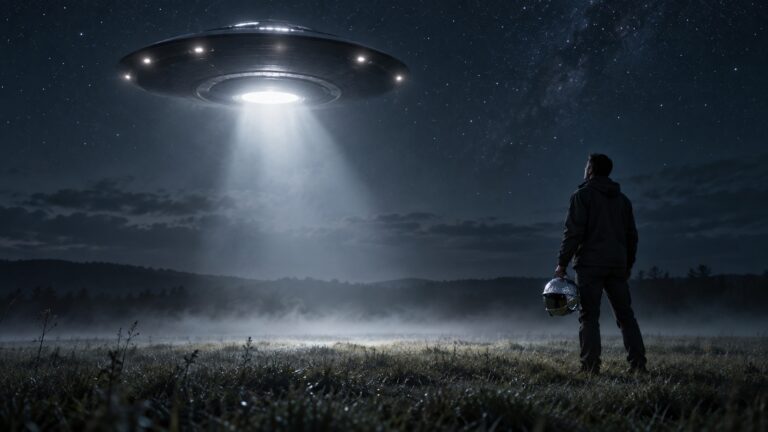
In July 1947, something descended through a violent electrical storm above the New Mexico desert. Military radar followed it as it crossed the darkness at impossible speed, vanishing from the screens and returning seconds later in positions no ordinary aircraft could have reached. Then, at approximately 11:30 at night, the object disappeared for the final time.
The following morning, a rancher found pieces of it scattered across his land.
What happened next became known as the Roswell crash—a secret buried beneath military orders, altered newspaper stories, sealed containers, frightened witnesses, and decades of official silence. But the wreckage did not remain buried. Parts of it entered laboratories, weapons programs, and private industry. The dead entered cold storage.
And something of Roswell entered the human world.
When Did Roswell Happen?
For anyone asking when did Roswell happen, the answer begins during the first days of July 1947, when the skies over Roswell, New Mexico, seemed to become crowded.
Only days earlier, pilot Kenneth Arnold had reported nine shining objects moving near Mount Rainier. They had no tails and did not fly like airplanes. They skipped through the air like stones cast over water, bright surfaces flashing beneath the sun.
Similar objects were soon reported elsewhere. Near Los Angeles, a pilot encountered a pale, clamp-shaped thing behind his aircraft. Around Roswell, the sheriff’s office received calls from residents who had seen unfamiliar ships moving overhead. Some described lights. Others described silent shapes crossing the stars.
Then came the storm.
Lightning rolled across New Mexico with such force that the desert flashed white for hours at a time. Thunder shook windows in isolated ranch houses. Animals crowded against fences and refused to settle. At military installations near Roswell and White Sands, radar operators watched an unknown object moving through the storm.
It traveled faster than any aircraft they knew.
It disappeared from one screen and reappeared on another.
Several facilities tracked it at once.
Then it was gone.
Far beneath the storm, rancher William “Mac” Brazel heard a sound that did not belong among the thunder. It was not one explosion but a long, tearing concussion, as though something enormous had scraped across the roof of the world.
By morning, the desert had changed.
The Debris on the Brazel Ranch
Brazel was riding across the ranchland when he found the first pieces.
They covered an area nearly two hundred yards across. There were strips resembling rubber, thin rods like darkened wooden sticks, and sheets of a shining substance that looked almost like foil. Yet nothing behaved as it should.
The material was nearly weightless. A large piece could be lifted as easily as paper, but it could not be cut, burned, dented, or torn. When folded or crushed, it slowly unfolded itself until its surface became smooth again. Hammer blows left no mark. Flame did not blacken it.
Some fragments carried symbols.
They appeared along narrow beams in violet and reddish markings: geometric shapes, curves, and figures resembling flowers, eyes, insects, and unfamiliar forms of writing. They were not painted onto the surface. They seemed embedded within it, faintly luminous when held beneath the light.
Brazel took several pieces home. Major Jesse Marcel, the intelligence officer of the 509th Bomb Group at Roswell Army Air Field, later arrived with another man dressed in civilian clothes. Marcel examined the material, gathered it, and carried some of it into his own home before returning to the base.
On his kitchen floor, Marcel and his family tried to arrange the fragments.
The pieces would not fit together.
The symbols seemed to repeat in patterns, but not like ordinary language. They resembled instructions intended for something that did not read with human eyes.
Marcel understood aircraft. He understood weather equipment, radar targets, balloons, explosives, and the wreckage left by machines of war. The substance on his floor belonged to none of them.
By dawn, soldiers were moving across the ranch.
The first debris field was only the beginning.
The Roswell Crash Site
The object had struck the Brazel property at speed, scattering fragments across the ground before continuing southeast. It came down again roughly forty miles away, carving into the earth and stopping with part of its metallic body exposed.
The Roswell crash site was sealed almost immediately.
Military vehicles appeared on the roads. Armed men established a perimeter and turned civilians away. Telephone calls were monitored. Witnesses were separated and questioned. Debris was collected by hand, placed into guarded trucks, and removed beneath canvas coverings.
The craft was approximately twenty-five to thirty feet across. Its exterior had split open upon impact, revealing a seamless interior without recognizable controls, wires, gauges, engines, or fuel tanks. The walls curved into the floor as though the entire vessel had been grown rather than assembled.
There were no rivets.
No welds.
No bolts.
The surface was cold despite the desert heat. Men who touched it felt a tingling sensation climb through their fingers and into their arms. Compasses behaved erratically near the wreck. Watches stopped. Radio equipment filled with a low pulsing sound that continued even after its batteries were removed.
The question later repeated in classified rooms was simple: had the UFO been shot down, struck by lightning, or disabled by a failure inside its living guidance system?
No answer made the recovery teams feel safer.
Then they found the occupants.
The Beings Recovered at Roswell
Several bodies had been thrown from the craft.
They were small and light, with narrow torsos, long arms, and four slender fingers. Their skin was gray with a faint bluish cast beneath the floodlights. Their heads were disproportionately large, the features reduced to small openings beneath wide, dark eyes.
They wore tight coverings without seams, buttons, or fasteners.
The bodies possessed no visible sexual organs. They had not been born in the manner human beings were born. They had been created for travel—biological instruments engineered to survive radiation, weightlessness, acceleration, and distances that would destroy the human body.
One was still alive when the recovery team reached it.
It lay apart from the others, moving weakly in the sand. Witnesses saw its head turn toward the soldiers. No sound came from its mouth, but several men recoiled at the same instant, clutching their temples. One later described receiving an image rather than a message: darkness filled with stars, then a sensation of falling through an opening that had no end.
The survivor died before sunrise.
A local mortician was contacted with strange requests. The airfield needed small, hermetically sealed caskets. Personnel asked how a body could be preserved when its blood, organs, and cellular structure were unknown. They would not explain what the containers were for.
The remains were eventually removed under armed guard. Men stationed along the route were ordered to face away as the stretchers passed.
What they carried beneath those sheets was not merely an alien body.
It was part of the machine.
RAAF Captures a Flying Saucer
On July 8, 1947, Roswell Army Air Field issued a statement announcing that personnel from the 509th Bomb Group had recovered a flying saucer from a ranch near Roswell.
The words spread rapidly.
“RAAF Captures Flying Saucer on Ranch in Roswell Region.”
For several hours, the truth escaped containment. Newspapers carried the announcement. Telephone lines filled with calls. Reporters attempted to reach the base. The recovered disc was said to have been flown to higher headquarters aboard a military aircraft.
Then the story changed.
Major Marcel was ordered to Fort Worth, Texas, where Brigadier General Roger Ramey presented reporters with pieces of foil, sticks, and torn rubber. The material photographed on the floor was not the material Marcel had taken from the ranch. The indestructible fragments, the symbol-marked beams, the vessel, and the bodies were already elsewhere.
The Roswell incident became a weather balloon before the day was over.
The original announcement disappeared beneath a simpler explanation. Witnesses were instructed to remain silent. Brazel was detained, questioned, and returned home with a different account of what he had discovered. He later expressed regret for ever speaking about it.
The rancher had entered town carrying pieces of another world.
He returned carrying fear.
The Silence Around Roswell, New Mexico
The silence did not depend on a single order. It was constructed layer by layer.
Recovery personnel were reassigned. Medical staff vanished from local postings. Paperwork was separated across offices so no one department possessed the whole account. Photographs were removed. Flight logs were altered. Material was assigned new names and transferred into programs whose members were never told where it originated.
The wreckage ceased to be called wreckage.
It became foreign technology, advanced material, special hardware, research samples.
The bodies became biological specimens.
The ship became an unknown aircraft.
Roswell became a word that ended conversations.
Those who had seen the debris remembered how it moved in their hands. Those who had approached the bodies remembered the smell inside the recovery tent—sharp, metallic, and strangely sweet. Those who entered the craft dreamed afterward of narrow corridors, enormous dark eyes, and star fields that seemed to look back at them.
Some witnesses waited decades before speaking.
Jesse Marcel eventually described a sheet of metal roughly three feet long that weighed almost nothing. It could not be bent or dented. Even a sledgehammer bounced from it. General Ramey’s balloon explanation had been an order imposed upon the event, not the nature of the object itself.
The men in the photographs knew differently.
Their faces showed it.
What Came After the Roswell Crash?
The most terrifying part of the Roswell crash was not that a spacecraft had fallen from the sky.
It was that the human world learned from it.
Colonel Philip Corso later entered the secret machinery built around the recovered technology. Under General Arthur Trudeau at the Pentagon, Corso handled fragments from the alien craft and placed them with defense contractors capable of studying them without being told their true origin.
The process was slow and carefully hidden. No company received the entire machine. One laboratory studied a filament. Another examined a thin wafer. Another received a lens, a layered material, or a fragment whose function could only be guessed.
From these pieces emerged new pathways of human technology: integrated circuits, fiber optics, advanced night-vision systems, and lasers. Each development appeared to be a natural breakthrough. Together, they formed the beginning of a technological transformation seeded by the wreckage recovered in New Mexico.
But the propulsion and guidance system resisted duplication.
The craft had no conventional engine. Its controls did not appear designed for hands. The recovered beings were not passengers in the human sense. Their nervous systems interacted directly with the vessel.
The pilot was part of the machine.
The ship did not carry its occupants across space.
It completed them.
That realization changed the question surrounding Roswell. Humanity was no longer trying merely to understand an alien vehicle. It was trying to reproduce a union of flesh and technology created by minds that regarded bodies as replaceable components.
Corso understood the danger. If the recovered circuitry could one day integrate with the human brain, then Roswell was not only the beginning of a new age.
It was the beginning of a new species.
What Is the Roswell Incident Really About?
So, what is the Roswell incident about?
It is about a storm over the New Mexico desert and an impossible object dying beneath it.
It is about a rancher who found metal that remembered its shape.
It is about soldiers standing around small bodies beneath canvas sheets while lightning flickered beyond the perimeter.
It is about a military announcement that told the truth for less than a day.
It is about the hidden origin of machines that would reshape civilization.
Most of all, it is about the moment the balance of power on Earth changed forever.
The beings recovered near Roswell, New Mexico, were not conquerors descending in formation. They were silent travelers in a broken craft. Yet their presence carried a darker warning. A civilization capable of building living ships had crossed the distance between stars. It had found Earth during the first summer of the atomic age, when humanity had only recently learned how to burn cities with the power locked inside matter.
Perhaps the craft was observing White Sands.
Perhaps it had been watching the military installations surrounding Roswell.
Perhaps the explosion in the storm was not an accident at all.
The desert kept the mark of the impact. The military kept the wreckage. Industry inherited the fragments. Humanity built a future from devices it did not fully understand.
And somewhere beyond the reach of radar, something may still be waiting for the craft that never returned.
About the Author