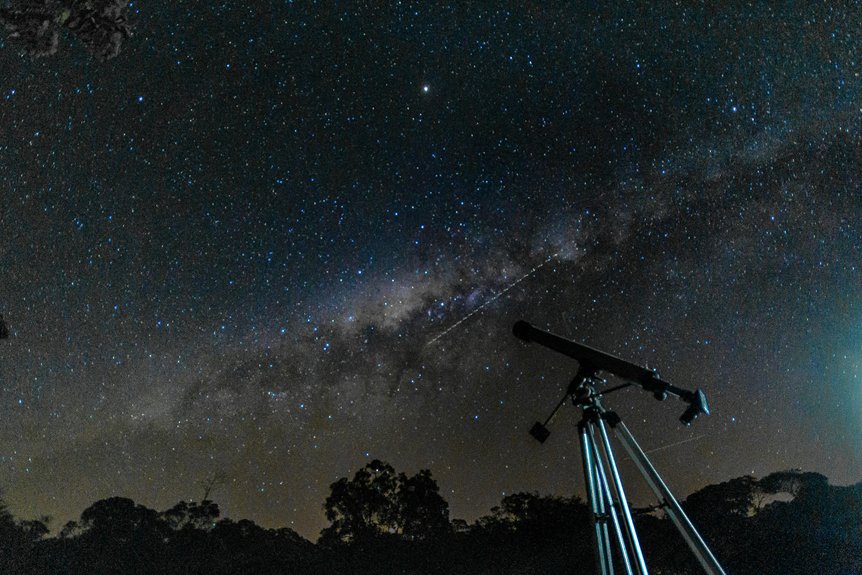
Have you ever wondered how telescopes bring the distant cosmos into focus? By capturing and manipulating light, these remarkable instruments allow you to explore the universe’s wonders. They rely on basic principles of optics, using lenses and mirrors to reveal celestial details. But there’s much more to the story than just glass and metal. Let’s uncover the science behind these tools and how they’ve evolved to enhance our view of deep space.
The History of Telescopes
Although many people associate telescopes with modern astronomy, their history stretches back over four centuries, beginning with a simple invention that changed our view of the universe.
In the early 1600s, Hans Lippershey, a Dutch spectacle maker, created the first known telescope, sparking a revolution in how we observe the night sky.
Galileo Galilei soon improved upon this design, using his telescope to make groundbreaking discoveries like Jupiter’s moons.
Galileo Galilei revolutionized astronomy with his enhanced telescope, unveiling the enigmatic moons of Jupiter.
As time progressed, innovators like Isaac Newton and William Herschel contributed significant advancements, enhancing the telescope’s power and clarity.
Each new design opened our eyes wider to the cosmos, fueling curiosity and inspiring generations to explore the mysteries beyond our planet.
This legacy continues to shape our understanding of the universe today.
Basic Principles of Optics
Light is the key player in the world of optics, and understanding its behavior is essential for grasping how telescopes function. Light travels in waves, bending and refracting as it passes through different materials. This bending allows telescopes to focus distant light into clear images.
Here’s a quick look at some fundamental concepts in optics:
| Concept | Description |
|---|---|
| Refraction | Bending of light when passing through different media |
| Reflection | Bouncing of light off surfaces |
| Dispersion | Separation of light into its colors |
| Focal Length | Distance from lens to focal point |
Types of Telescopes: Refractors vs. Reflectors
When diving into the world of telescopes, you’ll quickly notice two main types: refractors and reflectors.
Each type has its unique features and advantages that cater to different stargazing needs. Here’s a quick comparison to help you decide which one suits you:
- Refractors: Use lenses to bend light, offering sharp images, great for planetary observations.
- Reflectors: Utilize mirrors to gather light, providing larger apertures and better performance for deep-sky objects.
- Maintenance: Refractors generally require less upkeep, while reflectors need periodic mirror alignment.
- Cost: Reflectors often give you more aperture for your money, appealing to budget-conscious astronomers.
Choosing between these telescopes depends on your interests and how you want to explore the cosmos!
The Role of Lenses in Telescopes
Understanding how telescopes gather and magnify light leads us to the essential role of lenses in refractor telescopes. These optical wonders use glass lenses to bend and focus light, allowing you to see distant celestial objects with stunning clarity.
The primary lens, known as the objective lens, captures light and forms an image. The eyepiece lens then magnifies this image, making it easier for you to observe details.
The objective lens captures light to form an image, while the eyepiece lens magnifies it for detailed observations.
The shape and quality of these lenses directly affect the telescope’s performance; precise curvature and material choice are critical for reducing distortions and enhancing brightness.
As you explore the night sky, remember that these lenses transform your experience, turning faint star glimmers into breathtaking views of the universe.
The Function of Mirrors in Reflecting Telescopes
Reflecting telescopes harness the power of mirrors to gather and focus light, making them a popular choice among astronomers.
These innovative instruments use mirrors to enhance your viewing experience. Here’s how mirrors function in reflecting telescopes:
- Light Collection: The primary mirror captures light from celestial objects and reflects it inward.
- Focusing Light: The shape of the mirror, often parabolic, directs light to a single focal point.
- Image Formation: Light converges to create a clear image that’s magnified by an eyepiece.
- Reduced Aberrations: Mirrors minimize chromatic aberration, providing sharper views than lenses.
Mounting and Stability: Keeping the Telescope Steady
After you’ve set up your reflecting telescope and admired the clarity of the images produced by its mirrors, the next step is ensuring it remains steady during your observation sessions.
A stable mount is essential; it prevents vibrations that can blur your view of distant stars and planets. Consider using a sturdy tripod or an equatorial mount, which allows for smooth tracking of celestial objects as they move across the night sky.
You can also enhance stability by securing your telescope with weights or sandbags, reducing any chance of tipping. Always check for tight connections and proper alignment.
With a well-mounted telescope, you’ll maximize your stargazing experience, revealing the wonders of the universe with clear, sharp images.
The Importance of Aperture and Light Gathering
When it comes to observing celestial objects, the aperture of your telescope plays an essential role in determining the quality of your view. A larger aperture gathers more light, allowing you to see fainter objects and finer details.
Here are four reasons why aperture matters:
- Light Gathering Power: Bigger apertures collect more light, revealing dim stars and galaxies.
- Resolution: A larger aperture improves resolution, letting you distinguish between close celestial bodies.
- Contrast: Enhanced light gathering boosts contrast, making features on planets or the Moon more visible.
- Versatility: A telescope with a sizable aperture can be used for a variety of observations, from planets to deep-sky objects.
Investing in a telescope with a proper aperture can elevate your stargazing experience to new heights!
The Use of Filters in Observations
Have you ever wondered how filters can enhance your stargazing experience? Filters are essential tools that can dramatically improve your observations. By selectively blocking certain wavelengths of light, they allow you to focus on specific celestial features.
For instance, a nebula filter can help you see details in faint nebulae by cutting through the light pollution of the night sky. Meanwhile, color filters can enhance planetary details, revealing textures on surfaces that would otherwise go unnoticed.
Using these filters, you can deepen your understanding of celestial objects and uncover hidden wonders. So, the next time you set up your telescope, consider experimenting with different filters to elevate your astronomical adventures and transform how you see the universe.
Imaging Technology: From Film to Digital
As technology has evolved, the change from film to digital imaging has revolutionized the way you capture and share celestial wonders.
Digital cameras offer superior flexibility, allowing you to experiment with various settings while enjoying instant feedback.
Here are some key advantages of digital imaging in astronomy:
- Higher Sensitivity: Digital sensors can detect fainter objects, capturing more detail in your images.
- Immediate Results: You can view your images instantly, enabling quick adjustments for ideal shots.
- Editing Ease: Digital files are easily manipulated with software, enhancing your photographs with minimal effort.
- Storage Efficiency: Digital images take up less physical space, allowing you to store thousands of images without the clutter of film.
This change has made astrophotography more accessible, inspiring new generations of stargazers.
The Future of Telescope Technology and Exploration
The evolution of imaging technology has paved the way for exciting advancements in telescope design and functionality. As we look to the future, innovations like adaptive optics, space-based observatories, and AI-driven data analysis will reshape our exploration of the cosmos.
| Technology | Impact on Astronomy |
|---|---|
| Adaptive Optics | Improves image clarity by correcting atmospheric distortion |
| Space-Based Telescopes | Eliminates atmospheric interference, allowing clearer views |
| AI Data Analysis | Processes massive datasets, revealing hidden celestial phenomena |
| Multi-Wavelength Observations | Enhances understanding of cosmic events across different spectra |
| Quantum Sensors | Increases sensitivity to faint light, revealing distant objects |
These advancements hold the promise of uncovering new mysteries of the universe, making your stargazing experience more profound than ever.
About the Author


