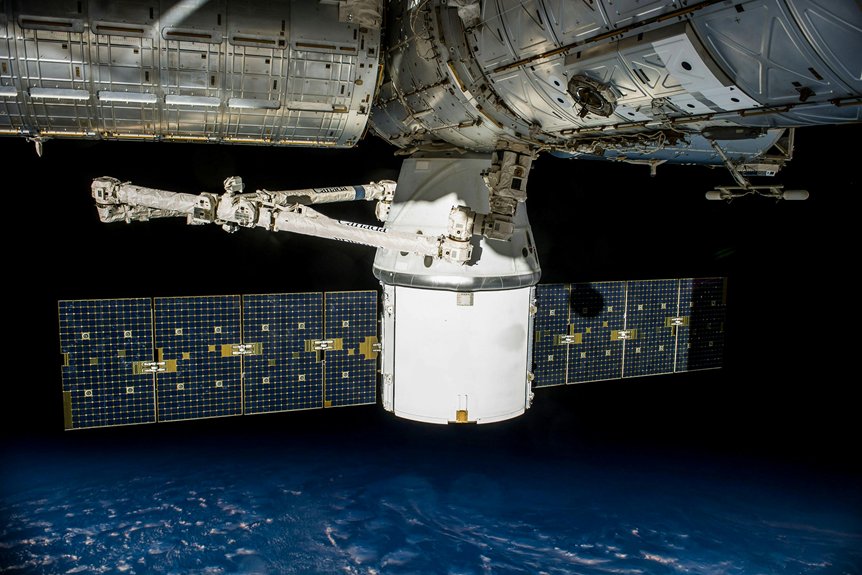
Imagine the Hubble Space Telescope gracefully gliding through the dark expanse of space, orbiting Earth at an astonishing speed. It’s not just a piece of machinery; it’s a window into the cosmos, tirelessly observing the universe. As it continues its mission, Hubble provides insights into phenomena like dark matter and exoplanets. Curious about what discoveries it’s still making and how it’s shaping our understanding of the universe? Let’s explore its current orbit and mission together.
Current Orbit and Position of Hubble
As you gaze up at the night sky, it’s fascinating to know that the Hubble Space Telescope orbits Earth at an altitude of about 547 kilometers (approximately 340 miles).
This position allows Hubble to escape most of the atmosphere’s interference, providing crystal-clear images of distant galaxies, nebulae, and other cosmic wonders.
With a speed of about 28,000 kilometers per hour (17,500 miles per hour), Hubble completes an orbit roughly every 95 minutes.
At a breathtaking speed of 28,000 kilometers per hour, Hubble orbits Earth every 95 minutes, unveiling cosmic wonders.
Its unique position means you can enjoy stunning views of the universe from your own backyard, knowing Hubble’s always working hard to capture them.
With each orbit, it’s not just a telescope in the sky; it’s a bridge connecting us to the vastness of space.
Hubble’s Ongoing Scientific Mission
Orbiting Earth at a height that minimizes atmospheric interference, Hubble’s scientific mission continues to push the boundaries of our understanding of the universe.
You can witness how this remarkable telescope provides invaluable data that fuels groundbreaking discoveries. Hubble captures stunning images and analyzes distant celestial phenomena, revealing secrets of the cosmos that were once beyond reach.
- It studies the formation of stars and galaxies, enhancing our knowledge of cosmic evolution.
- It investigates dark matter and dark energy, unraveling the mysteries that govern the universe’s expansion.
- It monitors exoplanets, offering insights into their atmospheres and potential habitability.
With each observation, Hubble inspires a new generation of scientists and dreamers alike, proving that our quest for knowledge is far from over.
Key Discoveries Made by Hubble
Since its launch, the Hubble Space Telescope has made a multitude of groundbreaking discoveries that have reshaped our understanding of the universe. You might be surprised by the wonders Hubble has revealed, from the expansion of the universe to the beauty of distant galaxies. Here’s a glimpse into some of its key findings:
| Discovery | Impact | Year |
|---|---|---|
| Expanding Universe | Led to the concept of dark energy | 1998 |
| Formation of Stars | Enhanced knowledge of stellar birth | Ongoing |
| Exoplanet Atmospheres | Provided insights into alien worlds | 2014 |
These discoveries not only ignite curiosity but also drive innovation in space exploration and science, pushing the boundaries of what we understand about our universe.
Hubble’s Instrumentation and Technology
Hubble’s remarkable discoveries are made possible by its sophisticated instrumentation and technology. With its cutting-edge gear, you can explore the universe like never before.
Here are some key components that make Hubble stand out:
- Wide Field Camera 3: Captures stunning images across various wavelengths, enhancing our understanding of celestial phenomena.
- Cosmic Origins Spectrograph: Analyzes the light from distant galaxies, revealing secrets about the universe’s formation and evolution.
- Space Telescope Imaging Spectrograph: Delivers detailed spectra, allowing you to study the composition and motion of astronomical objects.
These instruments work together to provide incredible insights, pushing the boundaries of what we comprehend about space.
Hubble’s technology continues to inspire innovation and curiosity in the field of astronomy.
The Importance of Hubble in Astronomy
The Hubble Space Telescope has become a cornerstone of modern astronomy, transforming how we comprehend the universe. By providing stunning, high-resolution images of distant galaxies, nebulae, and other celestial phenomena, Hubble allows you to explore the cosmos like never before.
Its ability to observe in ultraviolet, visible, and near-infrared wavelengths reveals details that ground-based telescopes simply can’t capture. Hubble’s discoveries have reshaped our understanding of dark matter, the expansion of the universe, and the formation of stars.
Each observation adds a piece to the cosmic puzzle, inspiring curiosity and innovation. As you investigate Hubble’s findings, you’ll appreciate its crucial role in pushing the boundaries of human knowledge, inviting you to dream bigger about the mysteries that lie beyond.
Notable Celestial Images Captured Recently
Recent observations from the Hubble Space Telescope have revealed breathtaking celestial images that capture the imagination and expand our understanding of the universe.
You’ll be amazed by the stunning visualizations Hubble continues to produce, showcasing the beauty and complexity of space.
- Pillars of Creation: Hubble’s latest capture of these iconic structures in the Eagle Nebula showcases star formation in breathtaking detail.
- Galactic Collisions: New images of merging galaxies highlight the dynamic processes shaping our cosmos and hint at the future of our own Milky Way.
- Exoplanet Atmospheres: Hubble’s observations of distant exoplanets provide insights into their atmospheres, paving the way for future explorations of potentially habitable worlds.
These images not only inspire wonder but also deepen our knowledge of the universe’s mysteries.
Collaborations With Other Space Observatories
While exploring the universe, scientists often rely on collaborations between Hubble and other space observatories to gain a more thorough understanding of celestial phenomena.
These partnerships enhance the depth of their research, allowing them to combine Hubble’s sharp optical imaging with the unique capabilities of other instruments, like the infrared observations from the James Webb Space Telescope.
Together, they reveal secrets of star formation, galaxy evolution, and more. By sharing data and findings, these observatories create a more complete picture of the cosmos.
Collaborative efforts unveil the mysteries of star formation and galaxy evolution, painting a richer portrait of the cosmos.
You’ll find that such collaborations not only boost scientific discoveries but also inspire innovation in technology and methodology, pushing the boundaries of what’s understood about our universe and fueling humanity’s quest for knowledge.
Challenges and Maintenance Updates
Collaboration among space observatories is essential, but it also comes with its own set of challenges, particularly when it comes to maintaining the Hubble Space Telescope.
As Hubble continues to orbit Earth, its aging systems require constant attention to guarantee peak performance. You might be surprised by the complexity involved in its upkeep:
- Aging components: Some instruments need replacement, while others face wear and tear.
- Software updates: Regular upgrades are necessary to keep Hubble compatible with new technologies.
- Remote diagnostics: Engineers constantly monitor systems for anomalies, adjusting operations from Earth.
These maintenance efforts are critical for Hubble’s continued contributions to science, allowing it to explore the cosmos and deliver stunning images that inspire future innovations.
Future Prospects for Hubble
As Hubble looks toward the future, its potential for groundbreaking discoveries remains bright, even as it faces challenges from newer observatories like the James Webb Space Telescope.
You can expect Hubble to continue delivering stunning images and crucial data, particularly in areas where it excels, such as ultraviolet light observations. Its unique capabilities allow it to complement other telescopes, creating a more complete view of the universe.
With ongoing maintenance and upgrades, Hubble’s lifespan could extend well into the 2030s. You’ll see it tackle questions about dark matter, galaxy formation, and more.
As it presses on, Hubble’s legacy won’t only endure but inspire future generations of astronomers to push the boundaries of our understanding even further.
How Hubble Continues to Inspire Generations
Hubble’s breathtaking images and groundbreaking discoveries ignite curiosity and wonder, drawing in not just professional astronomers but also budding scientists and the general public alike.
Its legacy inspires you to reach for the stars and explore the universe.
- Hands-On Learning: Many educational programs use Hubble’s findings to teach students about space, fostering interest in STEM fields.
- Artistic Inspiration: Artists and creators harness Hubble’s stunning visuals, blending science with creativity to inspire new works.
- Citizen Science: Hubble invites everyone to participate in research projects, making astronomy accessible and collaborative.
About the Author


