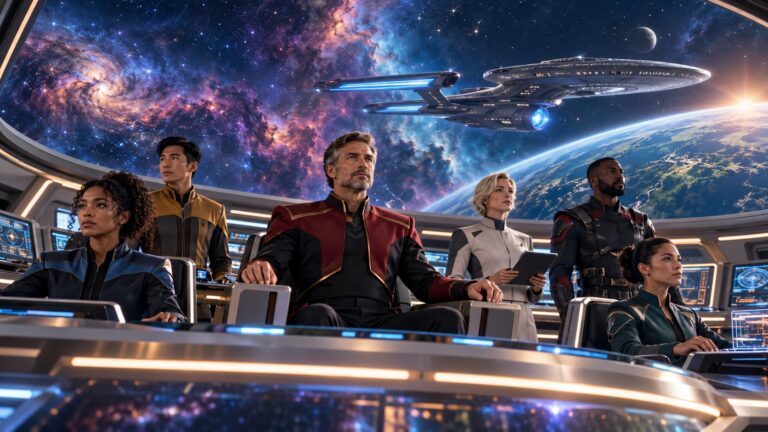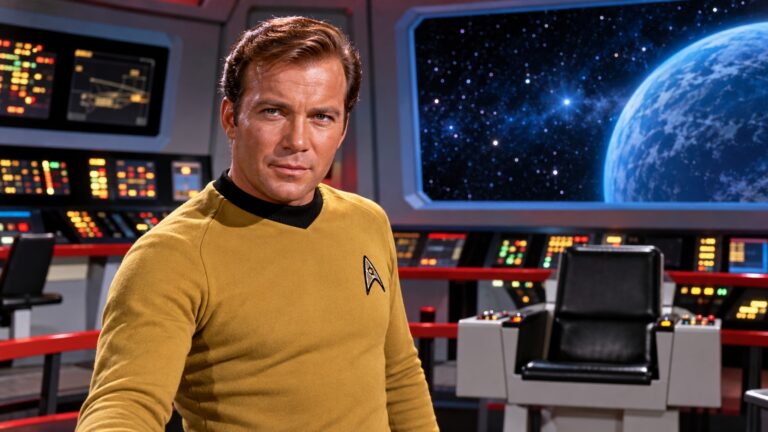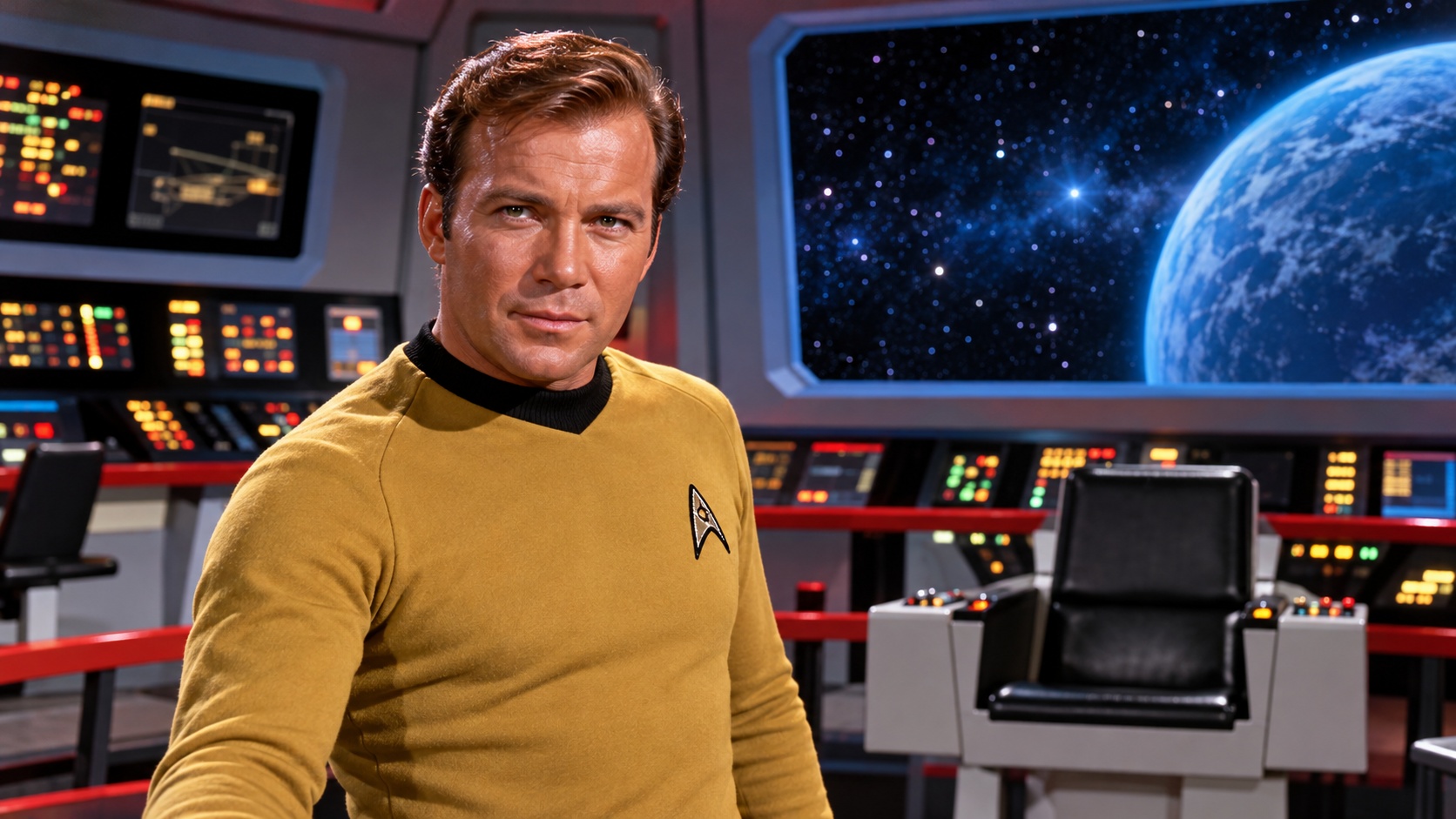
Few characters in science fiction are as recognizable as Captain James T. Kirk, the legendary commander of the USS Enterprise in Star Trek. With his gold Starfleet uniform, fearless leadership, and willingness to challenge impossible odds, Kirk became one of television’s most enduring heroes.
Originally portrayed by William Shatner in 1966, Captain Kirk has appeared across decades of television, animated adventures, blockbuster movies, and alternate timelines. More recently, Chris Pine and Paul Wesley have introduced the character to new generations of Star Trek fans.
But who exactly is Captain Kirk? Where was he born? How old is he? Does he actually die? And is it true that Michael Myers’ famous Halloween mask was originally a Captain Kirk mask?
From his fictional birthplace in Iowa to his dramatic final adventure alongside Jean-Luc Picard, here’s everything you need to know about Starfleet’s most famous captain.
TL;DR: Who Is Captain Kirk?
Captain James Tiberius Kirk is a fictional Starfleet officer best known for commanding the USS Enterprise NCC-1701 in Star Trek: The Original Series. Born on March 22, 2233, in Riverside, Iowa, Kirk became one of Starfleet’s most celebrated commanders.
William Shatner originated the role in 1966. Chris Pine portrays an alternate-timeline Kirk in the modern reboot movies, while Paul Wesley plays a younger Kirk in Star Trek: Strange New Worlds.
In the original Star Trek timeline, Kirk dies in the 1994 film Star Trek Generations, sacrificing his life while helping Captain Jean-Luc Picard stop a catastrophic threat.
And yes, the original Michael Myers mask from the 1978 horror film Halloween really was created by modifying a commercially available Captain Kirk mask.
Who Is Captain Kirk in Star Trek?
Captain James T. Kirk is a human Starfleet officer and one of the central characters of the Star Trek universe created by Gene Roddenberry.
He is best known for commanding the Constitution-class USS Enterprise, registry NCC-1701, during its historic five-year mission to explore strange new worlds, discover new civilizations, and investigate the unknown.
Although Star Trek was filled with futuristic technology, alien civilizations, and interstellar conflicts, Kirk was unmistakably human.
He was ambitious, emotional, occasionally reckless, and sometimes stubborn. Yet he was also intelligent, compassionate, and deeply loyal to his crew.
Kirk’s leadership combined three qualities that made him particularly effective: strategic thinking, personal courage, and a refusal to surrender simply because the odds appeared unfavorable.
He regularly challenged computers, alien authorities, hostile military commanders, and seemingly omnipotent beings. But his most important decisions were often moral ones.
For Kirk, Starfleet’s mission was not simply to conquer space or accumulate scientific knowledge. It was to explore the universe while protecting life and upholding the principles of the United Federation of Planets.
What Does the T in James T. Kirk Stand For?
Captain Kirk’s full name is James Tiberius Kirk.
His middle name, Tiberius, comes from his paternal grandfather. His first name, James, honors his maternal grandfather.
The name Tiberius also recalls the Roman emperor, giving the character an appropriately grand-sounding middle name.
Where Was Captain Kirk Born?
According to the established Prime Timeline of Star Trek, Captain Kirk was born on March 22, 2233, in Riverside, Iowa, on Earth.
His parents were George Kirk and Winona Kirk. He also had an older brother, George Samuel Kirk, commonly known as Sam.
Although the events of Star Trek take place centuries in the future, Riverside is a real American town that has embraced its fictional connection to one of science fiction’s greatest characters.
The community officially celebrates its designation as Kirk’s future birthplace.
Visitors can find Star Trek-related attractions and the annual TrekFest celebration, which attracts fans interested in honoring the franchise’s legacy.
The city even operates a Voyage Home museum with exhibits connected to its Star Trek history.
Was Captain Kirk Born on a Spaceship?
That depends on which Star Trek timeline you’re watching.
In the original continuity, Kirk was born in Iowa.
However, the 2009 film Star Trek, directed by J.J. Abrams, introduces an alternate reality known as the Kelvin Timeline.
In that version, James Kirk is born aboard an evacuating shuttle during the destruction of the USS Kelvin, after the vessel is attacked by the Romulan ship Narada.
His father, George Kirk, sacrifices himself to protect the escaping crew, including his pregnant wife and newborn son.
This event changes the younger Kirk’s upbringing and helps establish the alternate history explored in the reboot movies.
Both versions are legitimate parts of the Star Trek multiverse, but they have different personal histories.
How Old Is Captain Kirk?
Captain Kirk’s age depends on which period of his fictional life you’re examining.
Because he was born in 2233, Kirk is approximately 32 to 36 years old during the original Enterprise five-year mission, generally placed between 2265 and 2269.
During The Deadly Years, an episode of the original series, Kirk is established as being 34 years old.
By 2293, when he disappears aboard the Enterprise-B in Star Trek Generations, Kirk is approximately 60.
The Nexus, an extraordinary energy phenomenon in which Kirk becomes trapped, complicates his age considerably.
When he returns to the outside universe in 2371, 78 years have passed since his disappearance. However, Kirk has not physically aged through those intervening decades in the ordinary way.
Consequently, he is approximately 60 years old biologically when he dies, despite the calendar placing his death 138 years after his birth.
How Old Would Captain Kirk Be Today?
Kirk is a fictional character whose birth year is 2233, so he has not yet been born according to our real-world calendar.
If you’re asking about the actor who originally portrayed him, William Shatner was born on March 22, 1931, and turned 95 years old in 2026.
Who Played Captain Kirk in Star Trek?
Three actors are particularly associated with the role of James T. Kirk in official live-action Star Trek productions.
William Shatner: The Original Captain Kirk
Canadian actor William Shatner originated the role in Star Trek: The Original Series, which aired from 1966 to 1969.
Shatner’s performance helped define Kirk’s personality: charismatic, confident, decisive, and capable of switching between humor and serious command responsibility.
He also voiced Kirk in Star Trek: The Animated Series and returned for seven theatrical Star Trek films, ending with Star Trek Generations in 1994.
For many fans, Shatner remains the definitive Captain Kirk.
Chris Pine: Captain Kirk in the Reboot Movies
Chris Pine took over the role in J.J. Abrams’ 2009 Star Trek film.
Pine’s younger Kirk is initially more impulsive and rebellious than Shatner’s established captain, reflecting the altered circumstances of his upbringing.
He subsequently reprised the role in Star Trek Into Darkness (2013) and Star Trek Beyond (2016).
These movies belong to the Kelvin Timeline rather than the original continuity.
Paul Wesley: Young Kirk in Strange New Worlds
Paul Wesley portrays a younger James T. Kirk in Star Trek: Strange New Worlds.
Unlike Chris Pine’s interpretation, Wesley’s principal version of the character belongs to the original Prime Timeline.
The series follows Kirk before his famous Enterprise command, allowing audiences to see him develop as an officer.
He serves aboard the USS Farragut, rises through Starfleet’s ranks, and begins building relationships with officers whose names will eventually become synonymous with the Enterprise.
In the show’s third season, Kirk even temporarily assumes command of the Farragut during an emergency.
For longtime fans, these appearances provide additional insight into how the ambitious young officer developed into the captain portrayed by Shatner.
Captain Kirk’s Early Life and Starfleet Career
Kirk’s confidence did not emerge from a carefree childhood.
At approximately 13 years old, he survived the horrifying Tarsus IV massacre, where Governor Kodos ordered the deaths of thousands of colonists during a food crisis.
This traumatic experience is explored in the original series episode The Conscience of the King.
Kirk later attended Starfleet Academy, developing a reputation as a dedicated and exceptionally capable student.
Despite his later image as a swashbuckling adventurer, the young Kirk was described as intensely studious.
His academic achievements and increasingly impressive record eventually prepared him for one of Starfleet’s most prestigious assignments.
The Kobayashi Maru: Why Kirk Refused to Accept Defeat
One of the most famous stories about Kirk’s Academy years concerns the Kobayashi Maru simulation.
The exercise presents Starfleet cadets with a seemingly impossible rescue mission in which every available decision leads toward disaster.
Rather than accept defeat, Kirk secretly reprogrammed the simulation so that winning became possible.
His actions demonstrated an unusual willingness to rethink the rules rather than simply accept the conditions presented to him.
This incident became central to his character, establishing the belief that even apparently hopeless situations might contain an overlooked solution.
It also explains much of Kirk’s conduct throughout the original series.
When confronting a superior enemy, an impossible scientific problem, or a dangerous moral dilemma, he searches for an option nobody else has considered.
What Ship Did Captain Kirk Command?
Kirk is most famously associated with the USS Enterprise NCC-1701, a Constitution-class Federation starship.
Under his leadership, the Enterprise visited countless unexplored planets, encountered unfamiliar civilizations, and faced threats ranging from Klingon warships to powerful alien entities.
Following the destruction of the original Enterprise in Star Trek III: The Search for Spock, Kirk eventually receives command of the USS Enterprise NCC-1701-A.
His final major mission aboard that vessel takes place in Star Trek VI: The Undiscovered Country.
Who Were Captain Kirk’s Most Famous Crew Members?
The officers who served alongside Kirk became almost as famous as the captain himself.
Spock, the Enterprise’s Vulcan first officer and science officer, provided logical analysis and became Kirk’s closest friend.
Dr. Leonard “Bones” McCoy served as chief medical officer, frequently challenging both Kirk’s judgment and Spock’s emotionally detached reasoning.
Montgomery “Scotty” Scott was the Enterprise’s resourceful chief engineer, responsible for maintaining the ship and regularly accomplishing what appeared technically impossible.
Hikaru Sulu served at the helm, while Nyota Uhura handled communications. Pavel Chekov later joined the principal bridge crew as navigator.
Together, these characters formed one of television’s most recognizable science-fiction ensembles.
For a more detailed breakdown of the actors and officers throughout the franchise, see our complete guide to the Star Trek staff, cast, and crews.
What Does Captain Kirk Say Instead of “Engage”?
One of the most frequently asked Star Trek questions concerns the command captains use when ordering their ships into motion.
Jean-Luc Picard is especially famous for saying “Engage,” often after giving an order to set a course or initiate warp drive.
Captain Kirk, however, never established one equally consistent signature command.
Instead, he frequently used straightforward navigational instructions, such as “Warp speed,” “Ahead, warp one,” or variations of “Ahead, warp factor one.”
He often addressed his helmsman directly, instructing Mr. Sulu to take the Enterprise toward its next destination.
Kirk did occasionally use the word “engage,” but it was not his defining catchphrase in the way it became associated with Picard.
This difference fits the two captains’ personalities.
Picard generally favored precise, restrained commands, while Kirk’s bridge dialogue often sounded like the instructions of a traditional naval commander.
Did Captain Kirk Ever Say “Beam Me Up, Scotty”?
Surprisingly, Captain Kirk never said the exact phrase “Beam me up, Scotty” in Star Trek: The Original Series.
The expression is one of the most famous examples of a quotation becoming more popular than the actual dialogue from which it supposedly originated.
Kirk regularly ordered the Enterprise’s transporter operators to retrieve people from planetary surfaces or other locations.
He also issued commands such as “Energize.”
However, the precise wording “Beam me up, Scotty” does not appear as a Kirk line in the original series.
Over time, fans and popular culture condensed his various transporter instructions into that memorable expression.
The phrase became so closely associated with Star Trek that many viewers assume they remember hearing Shatner deliver it.
It’s a fascinating example of how television catchphrases can evolve independently of their original source.
Other Famous Captain Kirk Quotes
Among Kirk’s most memorable statements is “I don’t believe in a no-win scenario,” from Star Trek II: The Wrath of Khan.
The line captures the attitude that defines much of his character.
Another memorable line comes from the original series episode The Corbomite Maneuver, when Kirk declares that “Risk is our business.”
Kirk’s willingness to accept danger reflects his belief that exploration requires courage and an openness to the unknown.
Yet his most important lessons are not always about winning. Throughout the series and films, Kirk repeatedly learns that leadership also requires sacrifice, humility, and responsibility.
How Did Captain Kirk Die in Star Trek?
Captain James T. Kirk dies in the 1994 movie Star Trek Generations, during an attempt to stop the villain Dr. Tolian Soran from destroying a star system.
The circumstances of Kirk’s death are more complicated than they initially appear, because the film involves a mysterious phenomenon called the Nexus.
Kirk’s Disappearance in 2293
At the beginning of Star Trek Generations, a retired Kirk attends the maiden voyage of the USS Enterprise-B.
During an emergency rescue operation, the Enterprise encounters an energy ribbon known as the Nexus.
Kirk helps save the vessel but disappears during the crisis and is presumed dead.
For decades, Starfleet believes that the legendary captain lost his life aboard the Enterprise-B.
However, Kirk has actually entered the Nexus, where time and reality behave differently.
Kirk Meets Captain Jean-Luc Picard
In 2371, Jean-Luc Picard also enters the Nexus while attempting to stop Soran.
Inside the phenomenon, Picard discovers Kirk living in an idealized reality.
Picard eventually persuades him to return to the normal universe and help prevent Soran’s destruction of the Veridian system.
The two Enterprise captains work together to stop the villain.
During their confrontation on Veridian III, Kirk attempts to retrieve a crucial control device from a metal structure.
The structure collapses, and Kirk falls with it, suffering fatal injuries.
Although Soran is defeated and countless lives are saved, Kirk dies from his injuries.
Picard remains beside him during his final moments and subsequently creates a makeshift grave.
What Were Captain Kirk’s Last Words?
Kirk’s final moments in Star Trek Generations emphasize his lifelong fascination with adventure.
His final spoken words are:
“Oh my.”
The understated line is delivered shortly after Kirk reflects on the experience of confronting another extraordinary challenge.
For a character who spent his life exploring the unknown, his death represents one last encounter with something beyond human understanding.
Is Captain Kirk Still Alive?
In the original Prime Timeline, Captain Kirk is dead following the events of Star Trek Generations.
However, the franchise’s use of alternate timelines, time travel, and unusual scientific phenomena means that younger or alternate versions of Kirk can continue appearing.
That distinction is especially important when discussing Chris Pine’s films and Paul Wesley’s appearances.
Did Star Trek: Picard Bring Captain Kirk Back?
The third season of Star Trek: Picard includes a mysterious reference to Kirk’s remains.
During an investigation of Daystrom Station, a highly restricted Starfleet facility, the characters discover evidence that Kirk’s body has been recovered and placed in storage.
This suggests that the captain’s remains were retrieved from Veridian III after his burial.
However, the scene does not establish that Kirk has been resurrected.
Instead, it introduces an intriguing unanswered question about why Starfleet would preserve the remains of one of its greatest officers.
The distinction matters: discovering Kirk’s body is not the same thing as confirming that the character has returned to life.
Does Captain Kirk Die in Star Trek Into Darkness?
Yes, but only temporarily.
In the alternate Kelvin Timeline film Star Trek Into Darkness, Kirk enters a dangerously irradiated engineering compartment to save the Enterprise.
The exposure kills him, reversing the famous sacrifice made by Spock in The Wrath of Khan.
However, Dr. McCoy subsequently revives Kirk using regenerative properties associated with Khan’s genetically engineered biology.
That version of Kirk therefore survives and continues his adventures in Star Trek Beyond.
Is the Michael Myers Mask Really a Captain Kirk Mask?
One of the strangest connections between science fiction and horror cinema is entirely true.
The original Michael Myers mask used in John Carpenter’s 1978 horror classic Halloween was a modified Captain Kirk mask based on William Shatner’s likeness.
The film’s production team needed an unsettling mask for its seemingly emotionless killer, but the movie had a limited budget.
A commercially available Captain Kirk mask offered an inexpensive starting point.
Production designer and editor Tommy Lee Wallace transformed it into the terrifying face that audiences now associate with Michael Myers.
The modifications included painting the face white, enlarging the eye openings, and altering the hair.
The result was dramatically different from Shatner’s familiar appearance as the confident Enterprise captain.
The blank expression and pale coloring made the mask appear almost inhuman.
Did William Shatner Know About the Michael Myers Mask?
Shatner has discussed the unusual connection in interviews, explaining that he was surprised to discover his likeness had become the face of one of horror cinema’s most famous villains.
The mask’s history has also been confirmed by people involved in the Halloween productions.
It’s a remarkable piece of Hollywood trivia: the same face associated with one of science fiction’s greatest heroes became the inspiration for one of cinema’s most frightening killers.
Captain Kirk’s Most Important Star Trek Episodes
Anyone interested in understanding Kirk beyond his pop-culture reputation should explore several classic episodes of the original television series.
The Corbomite Maneuver
Kirk encounters a mysterious and seemingly overwhelming opponent. The episode demonstrates his skill with psychological strategy and his willingness to bluff when conventional defenses are ineffective.
Balance of Terror
The Enterprise confronts a Romulan vessel in a tense battle resembling submarine warfare. Kirk must balance tactical aggression with his responsibilities as a commander and his commitment to overcoming prejudice.
The City on the Edge of Forever
Frequently regarded as one of Star Trek’s greatest episodes, this time-travel adventure forces Kirk to make a devastating personal choice to preserve history.
Space Seed
Kirk encounters Khan Noonien Singh, a genetically engineered human from Earth’s past. The story introduces one of his most formidable enemies and establishes the conflict revisited in The Wrath of Khan.
The Trouble with Tribbles
This beloved comedic episode showcases a lighter side of Kirk as the Enterprise encounters a rapidly multiplying species of adorable but troublesome creatures.
The Conscience of the King
Kirk investigates a possible connection between an actor and the infamous Governor Kodos, confronting painful memories from his childhood.
Together, these episodes reveal far more about Kirk than the familiar image of a captain fighting aliens or charming attractive strangers.
They portray a leader who must continually navigate uncertainty, responsibility, and the consequences of his decisions.
Captain Kirk in the Star Trek Movies
Kirk’s story continued long after the original television series ended.
In Star Trek: The Motion Picture (1979), Kirk returns to command the Enterprise during a mysterious threat to Earth.
Star Trek II: The Wrath of Khan (1982) challenges him with an old enemy, questions about aging, and the devastating loss of Spock.
Star Trek III: The Search for Spock (1984) explores the consequences of Kirk’s loyalty to his closest friend.
Star Trek IV: The Voyage Home (1986) sends Kirk and his crew into Earth’s past on a mission involving humpback whales.
Star Trek V: The Final Frontier (1989) follows the crew in a confrontation involving faith, personal pain, and the search for a supposedly divine being.
Star Trek VI: The Undiscovered Country (1991) places Kirk at the center of a political crisis involving the Klingon Empire and the possibility of lasting peace.
Finally, Star Trek Generations (1994) connects Kirk’s legacy to that of Captain Jean-Luc Picard and concludes his life in the Prime Timeline.
The reboot films—Star Trek (2009), Into Darkness (2013), and Beyond (2016)—then introduce a separate version of Kirk for a different generation.
Why Is Captain Kirk So Famous?
Captain Kirk became a cultural icon because he represented a particular vision of humanity’s future.
At a time when Cold War anxieties and nuclear tensions shaped public life, Star Trek imagined a future in which humanity had expanded beyond Earth and cooperated with people from radically different backgrounds.
Kirk commanded a starship whose crew included people from diverse nationalities and, most importantly, different planets.
His friendship with Spock demonstrated that logic and emotion could complement one another rather than remain permanent opposites.
His arguments with Dr. McCoy revealed the human costs of decisions that might otherwise appear scientifically or strategically justified.
And his willingness to challenge authority reflected a recurring Star Trek idea: institutions and rules matter, but they should not replace moral judgment.
Kirk certainly has flaws. He can be overconfident, impatient, and personally reckless.
But those imperfections make him more interesting than an infallible fictional hero.
He is a captain who occasionally makes mistakes, learns from experience, and must decide what kind of person he wants to be.
That combination helped turn a character from a relatively short-lived 1960s television series into a science-fiction legend.
Frequently Asked Questions About Captain Kirk
Who played Captain Kirk on the original Star Trek?
William Shatner portrayed James T. Kirk in Star Trek: The Original Series, which aired from 1966 to 1969. He later returned for the animated series and seven theatrical movies.
Who plays Captain Kirk in the newer Star Trek movies?
Chris Pine portrays Kirk in the Kelvin Timeline movies beginning with Star Trek (2009).
Who plays Captain Kirk in Strange New Worlds?
Paul Wesley portrays the younger James T. Kirk in Star Trek: Strange New Worlds, including appearances that explore his career before commanding the Enterprise.
Where is Captain Kirk from?
In the original continuity, Kirk is from Riverside, Iowa, United States, Earth. In the Kelvin Timeline, he is born aboard an escaping spacecraft during the destruction of the USS Kelvin.
When was Captain Kirk born?
James Tiberius Kirk was born on March 22, 2233, according to the established Prime Timeline.
How old was Captain Kirk in the original series?
Kirk was approximately 32 to 36 years old during the original five-year Enterprise mission. He was 34 during the events of The Deadly Years.
How old was Captain Kirk when he died?
Kirk was approximately 60 years old biologically when he died in Star Trek Generations, although his death occurred in 2371, 138 calendar years after his birth.
How old is William Shatner?
William Shatner was born on March 22, 1931. He turned 95 in March 2026.
Is William Shatner still alive?
Yes. As of October 2026, William Shatner is alive. The death of James T. Kirk in Star Trek is fictional and should not be confused with the real actor.
What does Captain Kirk say to go to warp?
Kirk frequently gives direct navigational orders such as “Warp speed” or instructions to proceed at a specified warp factor. Unlike Captain Picard, he is not primarily associated with the single-word command “Engage.”
Did Captain Kirk say “Beam me up, Scotty”?
Not in those exact words in the original television series. The familiar expression developed from Kirk’s many transporter-related commands.
Is the Michael Myers mask a Captain Kirk mask?
Yes. The original Michael Myers mask from Halloween (1978) was made by modifying a commercial Captain Kirk mask based on William Shatner’s appearance.
How does Captain Kirk die?
In the Prime Timeline, Kirk dies after a metal structure collapses during his attempt to help Jean-Luc Picard defeat Dr. Tolian Soran on Veridian III in Star Trek Generations.
Does Captain Kirk die more than once?
Different Star Trek timelines depict different events. The Prime Timeline Kirk dies in Generations, while the Kelvin Timeline Kirk temporarily dies and is revived in Into Darkness.
Was Captain Smek Inspired by Charlie Kirk?
There is no credible evidence that Captain Smek was inspired by Charlie Kirk.
Captain Smek is an alien character voiced by Steve Martin in DreamWorks Animation’s Home (2015). The movie was adapted from Adam Rex’s 2007 novel The True Meaning of Smekday.
The character’s origins predate the later online comparisons, jokes, and memes involving Charlie Kirk.
Captain Smek is also unrelated to James T. Kirk from Star Trek, despite their shared title of captain.
Final Thoughts: Captain Kirk’s Lasting Legacy
Captain James T. Kirk remains one of the defining heroes of science fiction.
From his beginnings as a young Starfleet officer to his legendary Enterprise command, Kirk embodies humanity’s desire to explore beyond familiar boundaries.
His adventures introduced millions of viewers to futuristic spacecraft, transporter technology, alien civilizations, and the possibility of a united humanity traveling among the stars.
But the technology was never the most important part of his story.
Kirk’s enduring appeal comes from his belief that courage, imagination, friendship, and perseverance can overcome challenges that initially seem impossible.
Whether portrayed by William Shatner, Chris Pine, or Paul Wesley, James T. Kirk continues to represent the adventurous spirit at the heart of Star Trek.
And more than half a century after the character first appeared on television, his greatest legacy remains the same: the belief that the universe is worth exploring, even when nobody knows what lies ahead.
Sources and Further Reading
- Star Trek: The Original Series — Official Series Guide
- In Defense of Captain James T. Kirk — StarTrek.com
- The Journey from Star Trek Generations to Picard’s Final Season — StarTrek.com
- Was Michael Myers’ Halloween Mask William Shatner’s Face? — StarTrek.com
- 50 Terms You Know Because of Star Trek — Paramount+
- Riverside, Iowa — Official City Website
About the Author