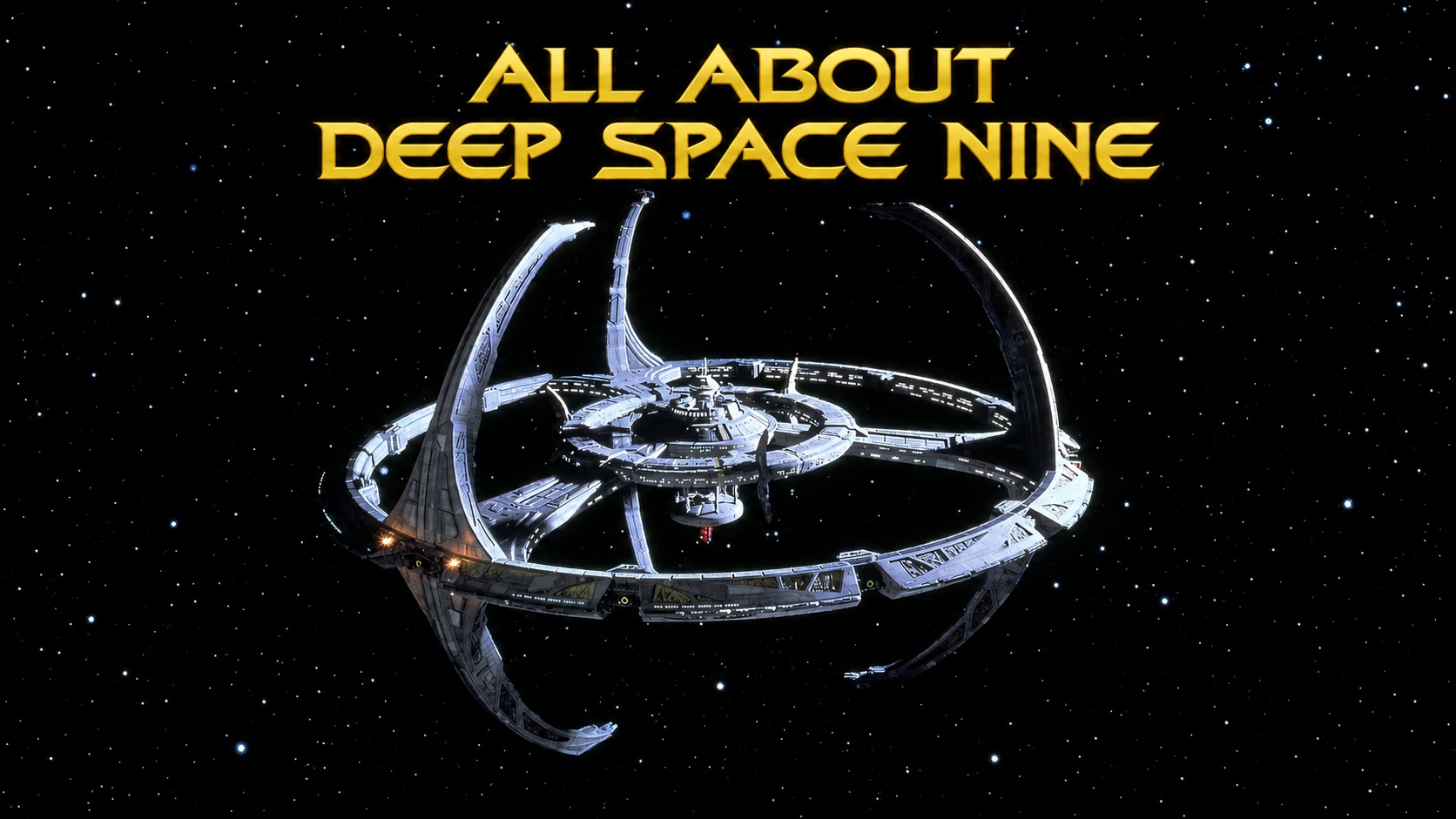
Star Trek: Deep Space Nine is a science-fiction television series set aboard a former Cardassian space station near the planet Bajor. Instead of traveling from planet to planet aboard a starship, its characters live and work at a strategic crossroads where politics, religion, commerce and war repeatedly collide.
The series follows Benjamin Sisko, a Starfleet officer assigned to command the station after the end of the Cardassian occupation of Bajor. His posting becomes far more important when the crew discovers a stable wormhole connecting the Bajoran system to the distant Gamma Quadrant.
The wormhole transforms Deep Space Nine from a damaged frontier outpost into one of the most important locations in the galaxy.
Over seven seasons, Star Trek: Deep Space Nine explores the recovery of Bajor, Sisko’s relationship with the mysterious Prophets, the rise of the Dominion, the moral cost of war and the complicated lives of people who cannot simply fly away when an episode ends.
The series originally ran from 1993 through 1999. The official Star Trek site counts 176 episodes, while some databases list 173 individual installments because several feature-length stories are counted as single entries.
Star Trek: Deep Space Nine Quick Facts
| Detail | Information |
|---|---|
| Full title | Star Trek: Deep Space Nine |
| Common abbreviation | DS9 |
| Original run | 1993–1999 |
| Number of seasons | 7 |
| Episode count | 176 broadcast episodes or 173 story installments |
| Creators | Rick Berman and Michael Piller |
| Primary setting | Deep Space 9 space station |
| Original Cardassian name | Terok Nor |
| Nearby planet | Bajor |
| Commanding officer | Benjamin Sisko |
| Major enemy | The Dominion |
| Final episode | What You Leave Behind |
| Current US streaming service | Paramount+ |
The show was created by Rick Berman and Michael Piller and produced during the period when Star Trek: The Next Generation was still on television. Unlike earlier Star Trek series, DS9 was built around a fixed location and a large recurring community.
What Is Star Trek: Deep Space Nine About?
The story begins after the Cardassian Union ends its decades-long occupation of Bajor.
The withdrawing Cardassians abandon Terok Nor, an ore-processing station they had operated near the planet. The Bajoran Provisional Government invites the United Federation of Planets to help administer the station and assist with Bajor’s recovery.
Starfleet sends Commander Benjamin Sisko to take command.
Sisko arrives with his son, Jake, while still grieving the death of his wife, Jennifer, at the Battle of Wolf 359. He does not initially view the assignment as a promising step in his career. The station is damaged, Bajor is politically unstable and many residents remain suspicious of outsiders.
Everything changes when Sisko and science officer Jadzia Dax discover a stable wormhole.
The Bajorans believe the beings living inside the wormhole are their gods, known as the Prophets. They call the wormhole the Celestial Temple. The Prophets identify Sisko as their Emissary, placing a reluctant Starfleet officer in the middle of Bajoran religious life.
The station is moved from Bajor’s orbit to a position near the wormhole. Deep Space Nine soon becomes a gateway to the Gamma Quadrant, drawing merchants, explorers, diplomats, refugees, criminals and hostile powers.
That setting gives the series its identity.
A starship can leave a troubled planet behind. Deep Space Nine cannot.
The consequences stay on the station.
Why Deep Space Nine Is Different From Other Star Trek Series
Most classic Star Trek stories are built around exploration.
A crew arrives somewhere new, encounters a problem and usually departs by the end of the episode. Deep Space Nine changed that formula by placing its characters in one location.
The Bajorans, Cardassians, Ferengi and other cultures were not simply visitors of the week. They returned constantly. Their governments changed. Their relationships evolved. Choices made in one season could reshape events years later.
This allowed DS9 to emphasize:
- Long-running political conflicts
- Serialized storytelling
- Character development
- Religious faith
- Colonial occupation
- Terrorism and resistance
- Economic inequality
- Espionage
- Family relationships
- The psychological effects of war
- Moral compromises made by democratic societies
The show still contains exploration, comedy, time travel and strange alien phenomena. It simply gives those stories a permanent social and political environment.
That structure has also helped Star Trek: Deep Space Nine age well in the streaming era. Viewers accustomed to serialized dramas can follow storylines that build across multiple seasons rather than resetting each week. Contemporary retrospectives frequently identify its long-form plotting, darker tone and layered characters as central to its continuing reputation.
Star Trek: Deep Space Nine Cast and Characters
The cast of Star Trek: Deep Space Nine includes Starfleet officers, Bajoran personnel, civilians, aliens, spies, merchants and political figures.
Many characters who begin as supporting players eventually become essential to the larger story.
| Actor | Character | Role on the series |
|---|---|---|
| Avery Brooks | Benjamin Sisko | Commander and later captain of Deep Space Nine |
| Nana Visitor | Kira Nerys | Bajoran first officer and former resistance fighter |
| René Auberjonois | Odo | Changeling and station security chief |
| Armin Shimerman | Quark | Ferengi bar owner and businessman |
| Terry Farrell | Jadzia Dax | Trill science officer |
| Nicole de Boer | Ezri Dax | Counselor and later host of the Dax symbiont |
| Alexander Siddig | Julian Bashir | Chief medical officer |
| Colm Meaney | Miles O’Brien | Chief of operations |
| Cirroc Lofton | Jake Sisko | Benjamin Sisko’s son |
| Michael Dorn | Worf | Starfleet officer and Klingon strategic operations officer |
| Andrew Robinson | Elim Garak | Cardassian tailor and former intelligence operative |
| Marc Alaimo | Gul Dukat | Former prefect of Bajor and recurring antagonist |
| Aron Eisenberg | Nog | Ferengi who becomes a Starfleet officer |
| Max Grodénchik | Rom | Quark’s brother and station engineer |
| Casey Biggs | Damar | Cardassian officer and later resistance leader |
| Jeffrey Combs | Weyoun | Dominion Vorta administrator |
| Louise Fletcher | Kai Winn | Bajoran religious and political leader |
The principal cast listed by official franchise pages includes Sisko, Kira, Odo, Worf, Quark, Jadzia Dax, Bashir, O’Brien and Jake Sisko. Michael Dorn joined the main DS9 cast as Worf beginning in season four, while Nicole de Boer played Ezri Dax in season seven.
Benjamin Sisko: Commander, Captain and Emissary
Avery Brooks plays Benjamin Lafayette Sisko, the central character of Star Trek: Deep Space Nine.
Sisko begins the series as a commander rather than a captain. He is promoted to captain at the end of season three in “The Adversary,” after already commanding the station for several years.
He is simultaneously:
- A Starfleet officer
- A single father
- The commander of a mixed Federation-Bajoran crew
- A diplomat
- A military leader
- The Emissary of the Prophets
These roles do not always agree with one another.
Sisko’s identity as the Emissary makes him unusual among Star Trek leads. He cannot dismiss Bajoran faith as primitive superstition because he has personally met the beings at its center. At the same time, his Starfleet training encourages him to interpret the Prophets as advanced non-corporeal aliens.
The tension between those explanations continues throughout the series.
Sisko also has one of the strongest family relationships in the franchise. His bond with Jake is not incidental background material. It shapes his priorities and shows the personal cost of his duties.
Kira Nerys
Nana Visitor plays Kira Nerys, a former member of the Bajoran resistance who becomes the station’s first officer.
Kira fought against the Cardassian occupation for most of her youth. She enters the series angry, suspicious of the Federation and uncertain whether Starfleet’s presence will truly help Bajor.
Her background gives her a very different moral perspective from the Starfleet characters.
To the Federation, political violence is generally a dangerous last resort. To Kira, armed resistance is the reason her people are free.
The series does not reduce that conflict to a simple lesson. Kira must confront what she did during the occupation, what freedom requires after victory and how former resistance fighters adapt when they become government officials.
Her relationship with Odo becomes one of the longest-running emotional threads in the series.
Odo
René Auberjonois plays Odo, the shape-shifting security chief of Deep Space Nine.
Odo was discovered without knowledge of his species or home. He can imitate many objects, but his humanoid appearance remains visibly unfinished. His face looks smooth because he cannot perfectly reproduce human features.
He values order and often presents himself as detached from politics. However, he served as a security officer while the Cardassians controlled Terok Nor, leaving him with difficult questions about neutrality and complicity.
Odo eventually learns that his people are the Founders, the rulers of the Dominion.
That discovery gives him the belonging he has always wanted. It also reveals that his species controls an authoritarian empire through manipulation, genetic engineering and military force.
His conflict between loyalty to his friends and longing for his people drives much of the Dominion storyline.
Quark
Armin Shimerman played Quark on Deep Space Nine.
Quark owns Quark’s Bar, Grill, Gaming House and Holosuite Arcade on the Promenade. He is a Ferengi businessman who claims that profit is the only reliable principle in the universe.
In practice, Quark is far more complicated.
He cheats customers, operates dubious schemes and repeatedly clashes with Odo. Yet he also helps the station during moments of crisis, protects people he claims not to care about and sometimes challenges the worst parts of Ferengi culture.
The rivalry between Quark and Odo provides comedy, but it also becomes a strange friendship. Each understands the other better than either is willing to admit.
Armin Shimerman’s performance helped transform the Ferengi from broadly comic villains into a culture with families, politics, religious beliefs, class divisions and internal reform movements.
Jadzia Dax
Terry Farrell plays Jadzia Dax during the first six seasons.
Jadzia is a Trill joined with the Dax symbiont. Although Jadzia is a young woman, Dax carries the memories and experiences of several previous hosts.
This gives her an unusual personality. She can be playful and adventurous while drawing on centuries of experience.
One former Dax host, Curzon, was a close friend and mentor to Sisko. That history explains why Sisko affectionately calls Jadzia “old man.”
Jadzia later marries Worf. Their relationship combines her enjoyment of Klingon culture with his far more serious understanding of Klingon honor.
Why Did Terry Farrell Leave Deep Space Nine?
Terry Farrell’s original contract ended after season six.
Farrell later explained that she wanted to remain associated with the series but hoped to reduce her workload and return as a recurring character rather than commit to another full season. A workable agreement was not reached.
She has described the negotiations as a take-it-or-leave-it situation and said that she was exhausted by the production schedule. Her character was consequently killed in “Tears of the Prophets,” and Farrell moved directly to the sitcom Becker.
The Dax symbiont survives and is transferred to a new host.
Ezri Dax
Nicole de Boer plays Ezri Dax in season seven.
Ezri had not planned to become joined. She receives the Dax symbiont during an emergency and arrives on the station with the memories of Jadzia and Dax’s earlier hosts.
Her lack of preparation distinguishes her from Jadzia.
Jadzia spent years training for joining. Ezri suddenly inherits several lifetimes of memories, relationships and emotional complications.
The character allows the final season to examine identity from a new direction. Worf must face someone who remembers being his wife but is not the same person.
Julian Bashir
Alexander Siddig plays Dr. Julian Bashir, the station’s chief medical officer.
Bashir initially appears overeager, privileged and socially awkward. He treats the frontier assignment like an adventure and immediately becomes fascinated by Garak.
Later seasons reveal greater complexity.
Bashir was genetically enhanced as a child after his parents became concerned about his development. Because genetic engineering is heavily restricted within the Federation, his abilities and family history were hidden.
He also becomes involved with Section 31, a secret organization willing to violate Federation law in the name of security.
Bashir’s friendship with Miles O’Brien becomes one of the show’s most convincing relationships.
Miles O’Brien
Colm Meaney plays Chief Miles O’Brien, who transfers from the USS Enterprise to become chief of operations on Deep Space Nine.
O’Brien must keep a damaged Cardassian station functioning with a mixture of incompatible Federation, Bajoran and Cardassian technology.
He is also a husband, father and veteran of the Federation-Cardassian border conflicts.
O’Brien is intentionally more ordinary than many Starfleet heroes. He becomes frustrated. He carries prejudice from wartime experiences. He worries about his family and complains about his work.
He also endures an almost absurd number of traumatic episodes, leading fans to jokingly describe “O’Brien must suffer” as its own DS9 genre.
Jake Sisko
Cirroc Lofton plays Jake Sisko.
Jake is not a Starfleet officer and does not aspire to become one. He wants to be a writer.
That decision gives the series a civilian view of Starfleet life. Jake grows up on the station, develops a close friendship with Nog and eventually works as a journalist during the Dominion War.
His relationship with his father remains central from “Emissary” through “What You Leave Behind.”
Worf
Michael Dorn joins the Deep Space Nine cast as Worf in season four.
Worf arrives during a political crisis between the Federation and the Klingon Empire. He becomes the station’s strategic operations officer and later develops a relationship with Jadzia Dax.
His move from The Next Generation helps connect the two series, but Worf is not merely transplanted into the new setting.
DS9 places him among Klingons far more often. It challenges his idealized understanding of Klingon honor and forces him to choose between Starfleet principles, Klingon politics and personal loyalty.
Elim Garak
Andrew Robinson plays Elim Garak, the station’s remaining Cardassian resident.
Garak claims to be a simple tailor.
Almost nobody believes him.
He is a former member of the Obsidian Order, Cardassia’s feared intelligence service. His stories regularly contradict one another, and he treats deception as both a survival skill and an art form.
Garak becomes an unlikely friend to Bashir and later plays an important role in the struggle against the Dominion.
He is one of the clearest examples of DS9 turning a recurring side character into someone essential.
Gul Dukat
Marc Alaimo plays Gul Dukat, the former Cardassian prefect of Bajor and commander of Terok Nor.
Dukat considers himself misunderstood. He insists that he governed Bajor with restraint and repeatedly seeks recognition from the people he helped oppress.
His refusal to accept responsibility makes him one of the series’ most disturbing villains.
Dukat moves through several roles, including military commander, political leader, resistance fighter, Dominion collaborator and religious fanatic. His obsession with Kira and Bajor becomes increasingly destructive.
Nog
Aron Eisenberg plays Nog, Quark’s nephew and Jake Sisko’s closest friend.
Nog begins as a poorly educated juvenile troublemaker. He eventually asks Sisko to sponsor his application to Starfleet Academy because he does not want to repeat his father’s limited life.
He becomes the first Ferengi to enter Starfleet.
Nog’s journey continues through the Dominion War, where he loses a leg in combat and later struggles with trauma. His recovery in “It’s Only a Paper Moon” gives the series one of its most affecting examinations of wartime injury.
What Is the Deep Space Nine Station?
Deep Space 9 was originally called Terok Nor.
The Cardassians constructed it during their occupation of Bajor as an ore-processing station. Bajoran laborers were forced to process materials there under brutal conditions.
After the occupation ended, the Cardassians abandoned and damaged the station. Starfleet and Bajoran personnel then assumed joint control and renamed it Deep Space 9.
Following the discovery of the Bajoran wormhole, the station was moved to a position near its Alpha Quadrant entrance. That made it a major center for trade, exploration and defense.
Important Locations on Deep Space Nine
The Promenade
The Promenade is the station’s commercial and social center.
It contains Quark’s Bar, the infirmary, Odo’s security office, shops, restaurants, a Bajoran temple and other public facilities. Its circular walkways and large viewports create one of the series’ most recognizable settings.
Ops
Operations, usually called Ops, is the station’s command center.
From there, the crew controls docking operations, communications, station security and defensive systems.
Quark’s Bar
Quark’s is a bar, restaurant, casino and holosuite business.
It functions as the station’s informal gathering place. Starfleet officers, merchants, criminals, politicians and travelers all pass through it.
The Habitat Ring
The habitat ring contains living quarters and other facilities.
Unlike a starship, Deep Space Nine houses many civilians and families. The station is a community as much as a military installation.
The Docking Ring and Pylons
Ships dock along the outer ring and large curved pylons.
The station’s Cardassian design gives it a silhouette unlike any Federation starbase.
The Bajoran Wormhole and the Gamma Quadrant
The Bajoran wormhole is the first known stable wormhole in the Star Trek setting.
It connects the Bajoran system in the Alpha Quadrant with a distant region of the Gamma Quadrant.
To Starfleet, it is a scientific phenomenon and strategic passage.
To the Bajorans, it is the Celestial Temple, home of the Prophets.
Both descriptions are accurate.
The discovery begins a new era of exploration and trade, but it also exposes the Alpha Quadrant to the Dominion. The same passage that brings opportunity eventually becomes the route through which a powerful empire threatens the Federation and its neighbors.
Star Trek: Deep Space Nine Seasons
Star Trek: Deep Space Nine Season 1
Season one introduces the station, Bajor and the main cast.
“Emissary” establishes Sisko’s trauma after Wolf 359, his assignment to Deep Space Nine and his first encounter with the Prophets.
The early episodes are more episodic than later seasons. They build the relationships and political circumstances that eventually support the larger arcs.
Important season-one episodes include:
- Emissary
- Captive Pursuit
- Dax
- The Nagus
- Progress
- Duet
- In the Hands of the Prophets
“Duet” is an early demonstration of what DS9 could become. Kira confronts a Cardassian suspected of being a war criminal, only to discover a far more complicated story involving guilt, responsibility and collective memory.
Star Trek: Deep Space Nine Season 2
Season two expands Bajoran politics and begins introducing threats beyond the station.
The opening three-part story, “The Homecoming,” “The Circle” and “The Siege,” follows an attempted political takeover on Bajor.
The season also introduces the Maquis, returns to the Mirror Universe and ends with the first direct confrontation with the Dominion.
Important season-two episodes include:
- The Homecoming
- The Circle
- The Siege
- Necessary Evil
- The Wire
- Crossover
- The Maquis
- The Tribunal
- The Jem’Hadar
“The Jem’Hadar” changes the direction of the series. The Dominion destroys a Galaxy-class starship with alarming ease and warns the Alpha Quadrant powers to stay away from its territory.
Star Trek: Deep Space Nine Season 3
Season three introduces the USS Defiant.
The Defiant gives the station crew a heavily armed starship capable of traveling through the wormhole and confronting the Dominion. It was originally developed to fight the Borg, but its power makes it useful on the dangerous frontier.
The season deepens the Dominion storyline and reveals that Odo’s people are the Founders.
Important episodes include:
- The Search
- Second Skin
- Civil Defense
- Defiant
- Past Tense
- Improbable Cause
- The Die Is Cast
- Explorers
- The Adversary
Sisko is promoted to captain in the season finale, “The Adversary.”
Star Trek: Deep Space Nine Season 4
Season four begins with “The Way of the Warrior.”
The Klingon Empire invades Cardassian space after becoming convinced that the Cardassian government has been infiltrated by Changelings. Worf arrives to assist Sisko and remains on the station.
The season brings a stronger military dimension to the series while continuing its political and personal stories.
Important episodes include:
- The Way of the Warrior
- The Visitor
- Rejoined
- Homefront
- Paradise Lost
- Return to Grace
- Hard Time
- To the Death
- Broken Link
“The Visitor” follows an alternate future in which Jake spends his life trying to rescue his father. It is frequently ranked among the finest episodes of the franchise.
Star Trek: Deep Space Nine Season 5
Season five pushes the Alpha Quadrant toward open war.
The Klingon conflict continues, the Dominion infiltrates major powers and Cardassia makes a catastrophic alliance with the Dominion.
The season also includes “Trials and Tribble-ations,” which digitally inserts the DS9 cast into footage from the original Star Trek episode “The Trouble with Tribbles.”
Important episodes include:
- Apocalypse Rising
- The Ship
- Nor the Battle to the Strong
- Trials and Tribble-ations
- For the Uniform
- In Purgatory’s Shadow
- By Inferno’s Light
- Doctor Bashir, I Presume?
- Soldiers of the Empire
- Children of Time
- Call to Arms
“Call to Arms” ends with Starfleet abandoning Deep Space Nine to the Dominion after mining the wormhole to prevent enemy reinforcements from entering the Alpha Quadrant.
Season five contains 26 episodes and marks the final escalation into the Dominion War.
Star Trek: Deep Space Nine Season 6
Season six opens with the station under Dominion and Cardassian control.
Sisko commands Federation forces from the Defiant while Kira, Odo, Quark, Rom and Jake remain aboard the occupied station.
The opening arc ends with “Sacrifice of Angels,” but the Dominion War continues through the rest of the season.
Important episodes include:
- A Time to Stand
- Rocks and Shoals
- Behind the Lines
- Favor the Bold
- Sacrifice of Angels
- Statistical Probabilities
- Waltz
- Far Beyond the Stars
- Inquisition
- In the Pale Moonlight
- The Magnificent Ferengi
- Tears of the Prophets
“In the Pale Moonlight” follows Sisko’s attempt to bring the Romulan Empire into the war. It forces him to decide how far he will go when Federation survival is at stake.
“Far Beyond the Stars” places Sisko in the role of a Black science-fiction writer facing racism in 1950s America.
Season six ends with the death of Jadzia Dax and the temporary closure of the wormhole. It is the height of the Dominion War arc.
Star Trek: Deep Space Nine Season 7
Season seven introduces Ezri Dax and brings the Dominion War to its conclusion.
The early episodes address Sisko’s connection to the Prophets, Worf’s grief and Ezri’s struggle with joining.
The final portion becomes a serialized closing arc covering the last stage of the war, political change on Cardassia and Dukat’s alliance with Kai Winn.
Important episodes include:
- Image in the Sand
- Shadows and Symbols
- Once More Unto the Breach
- The Siege of AR-558
- It’s Only a Paper Moon
- Chimera
- Inter Arma Enim Silent Leges
- The Changing Face of Evil
- Tacking Into the Wind
- The Dogs of War
- What You Leave Behind
Season seven contains 26 episodes. Its last ten installments function as an extended finale in which several long-running plots reach their conclusions.
How Many Deep Space Nine Episodes Are There?
The official Star Trek site lists 176 episodes.
Other databases list 173 installments because three feature-length stories are presented as single productions rather than two separate episodes.
The discrepancy is therefore a matter of counting, not missing material. The entire series consists of seven seasons produced between 1993 and 1999.
Best Deep Space Nine Episodes
Any ranking will be subjective, but the following episodes provide a strong introduction to what makes DS9 distinctive.
1. In the Pale Moonlight
Sisko attempts to bring the Romulans into the Dominion War and accepts increasingly serious moral compromises.
It is currently the highest-rated DS9 episode on IMDb.
2. The Visitor
An accident removes Sisko from normal time, leaving an older Jake obsessed with rescuing his father.
3. Far Beyond the Stars
Sisko experiences the life of Benny Russell, a Black science-fiction writer in 1950s New York.
4. Duet
Kira confronts a Cardassian connected to a notorious labor camp.
5. Trials and Tribble-ations
The crew travels back to the events of “The Trouble with Tribbles” and interacts with footage from the original series.
6. The Way of the Warrior
Worf arrives as the Klingon Empire prepares to attack Cardassia.
7. Sacrifice of Angels
The Federation launches an attempt to retake Deep Space Nine during the Dominion War.
8. The Die Is Cast
Garak and Odo become trapped aboard a doomed Obsidian Order and Tal Shiar mission.
9. The Siege of AR-558
Sisko and his crew join exhausted troops defending a strategically important communications installation.
10. It’s Only a Paper Moon
Nog uses Vic Fontaine’s holosuite program to avoid confronting his wartime trauma.
11. Necessary Evil
Odo investigates a murder connected to his first case on Terok Nor.
12. What You Leave Behind
The Dominion War ends and the characters prepare to leave the station or begin new phases of their lives.
The finale first aired on June 2, 1999, and closes the Dominion War while resolving Sisko’s role as Emissary and many of the show’s central relationships.
Deep Space Nine and the Tribbles
“Trials and Tribble-ations” was produced to celebrate the 30th anniversary of Star Trek.
The episode sends Sisko and several members of the DS9 crew back to Space Station K-7 during the events of “The Trouble with Tribbles.”
New footage was combined with scenes from the 1967 episode, allowing the later cast to appear beside Kirk, Spock, McCoy and Scotty.
The story also jokes about the difference between the smooth-headed Klingons seen in the original series and the ridged Klingons seen in later productions.
Worf refuses to explain the change in detail.
Deep Space Nine’s “Emissary”
“Emissary” is the feature-length premiere of Star Trek: Deep Space Nine.
The story introduces:
- Benjamin and Jake Sisko
- Kira Nerys
- Odo
- Quark
- Jadzia Dax
- Julian Bashir
- Miles O’Brien
- The station
- Bajor
- The Prophets
- The Bajoran wormhole
It also directly connects DS9 to The Next Generation through Captain Jean-Luc Picard.
Sisko resents Picard because Picard, while assimilated as Locutus, led the Borg attack at Wolf 359 where Jennifer Sisko was killed.
The Prophets eventually force Sisko to recognize that he is still emotionally living inside that moment.
The Dominion War
The Dominion is a Gamma Quadrant empire ruled by the Founders.
Its political system is built around the belief that shape-shifters can only remain safe by controlling humanoid civilizations, which the Founders call “solids.”
The Dominion maintains power through several engineered species:
- The Vorta act as administrators, diplomats and commanders.
- The Jem’Hadar serve as soldiers.
- Both are genetically conditioned to worship and obey the Founders.
The conflict develops gradually.
Early references suggest that Gamma Quadrant powers fear something called the Dominion. Direct contact occurs in “The Jem’Hadar.” Infiltration and political destabilization follow. Open war begins after Cardassia joins the Dominion and the Federation blocks the wormhole.
The war eventually involves the Federation, Klingon Empire, Romulan Empire, Cardassian Union, Breen Confederacy and the Dominion.
Unlike many television wars, it changes the characters.
Nog loses a leg. Sisko compromises his principles. Bashir confronts Section 31. Odo must choose between his people and the Alpha Quadrant. Cardassia experiences the consequences of the empire it helped build.
How Deep Space Nine Changed the Star Trek Franchise
DS9 demonstrated that Star Trek could sustain long-running serialized stories without abandoning episodic adventures.
It also questioned Federation ideals more directly than earlier series.
The Federation remains broadly democratic and hopeful. However, its institutions sometimes fail, compromise or conceal morally troubling actions.
The show asks difficult questions:
- Can an ethical society remain ethical during an existential war?
- When does resistance become terrorism?
- Can a person remain neutral under an occupation?
- Can faith and science describe the same phenomenon?
- What responsibility does a society have for crimes committed in its name?
- Can former enemies live together after liberation?
- Is victory meaningful if it destroys the principles being defended?
This place in the Star Trek franchise’s evolution has become clearer over time. Later series adopted serialized storytelling, political ambiguity and season-long conflicts that DS9 had already explored during the 1990s.
Deep Space Nine Streaming: Where Can You Watch It?
As of August 2026, all seven seasons of Star Trek: Deep Space Nine are available in the United States through Paramount+ and its associated Amazon, Apple TV and Roku channels.
The series can also be purchased digitally through services including Amazon Video, Apple TV and Fandango at Home. There are currently no permanent free US streaming options listed by JustWatch. Availability can change by country and over time.
Because streaming rights change, this section should be reviewed periodically.
Deep Space Nine on IMDb
The Star Trek: Deep Space Nine IMDb page currently carries an 8.1 out of 10 user rating based on approximately 78,000 ratings.
IMDb lists Rick Berman and Michael Piller as the creators and provides episode ratings, production credits and an extensive cast database.
“In the Pale Moonlight” and “Trials and Tribble-ations” are currently the two highest-rated individual DS9 episodes on the platform.
Will Deep Space Nine Be Remastered in HD?
Star Trek: Deep Space Nine has not received a complete official HD remaster.
The available streaming and DVD versions largely come from the standard-definition television masters created during the original production.
A proper remaster would require returning to the original film elements, rebuilding edits and recreating many visual-effects sequences. That process is technically possible but expensive.
The documentary What We Left Behind demonstrated what an HD version could look like. Its production team located and scanned original film elements to create more than 20 minutes of remastered DS9 footage, including newly reconstructed visual-effects shots.
As of August 2026, Paramount has not officially announced a complete remaster or full-series Deep Space Nine Blu-ray release.
Is Deep Space Nine Available on Blu-ray?
The complete television series has not been released as a fully remastered Blu-ray collection.
DVD collections remain available, and digital stores may describe their streams as HD depending on their delivery format. That does not mean the show has undergone the type of full reconstruction performed for Star Trek: The Next Generation.
The documentary What We Left Behind did receive a Blu-ray release with additional footage and special features.
The Deep Space Nine Documentary
What We Left Behind: Looking Back at Star Trek: Deep Space Nine is a retrospective documentary led by DS9 showrunner Ira Steven Behr.
It includes cast and crew interviews, discussion of the show’s legacy, remastered footage and a writers’ room segment imagining the opening of a hypothetical eighth season.
Avery Brooks did not participate directly in the documentary, although its producers later said he watched and approved of the finished film.
As of July 2026, the documentary was available through several US streaming and ad-supported services, although availability may change.
Star Trek: Deep Space Nine Technical Manual
The Star Trek: Deep Space Nine Technical Manual is a reference book written by Herman Zimmerman, Rick Sternbach and Doug Drexler.
It presents technical information from an in-universe perspective and includes diagrams and material covering:
- Deep Space 9
- The USS Defiant
- Runabouts
- Starfleet technology
- Bajoran equipment
- Cardassian technology
- Dominion ships and weapons
- Klingon and Romulan vessels
The manual was produced by members of the DS9 creative staff and focuses heavily on the Dominion War period.
It is useful for readers interested in the station’s layout, spacecraft and fictional engineering.
Star Trek: Deep Space Nine: Crossroads of Time
Star Trek: Deep Space Nine: Crossroads of Time is a video game released in 1995.
Versions were produced for the Super Nintendo Entertainment System and Sega Genesis, known as the Mega Drive outside North America.
The game uses a side-scrolling action-adventure format and places the player in the role of Benjamin Sisko. Its story involves events on the station, Bajor and other locations connected to the early seasons of DS9.
It is remembered as one of several 1990s attempts to adapt Star Trek into console action games rather than strategy or simulation titles.
Star Trek: Deep Space Nine FAQ
Who is the captain of Deep Space Nine?
Benjamin Sisko commands Deep Space Nine. He begins the series with the rank of commander and is promoted to captain at the end of season three.
Who played Quark on Deep Space Nine?
Armin Shimerman played Quark throughout the series.
Who played Kira on Deep Space Nine?
Nana Visitor played Kira Nerys.
Who played Odo on Deep Space Nine?
René Auberjonois played Odo.
Who played Dax on Deep Space Nine?
Terry Farrell played Jadzia Dax during seasons one through six. Nicole de Boer played Ezri Dax in season seven.
Who created Star Trek: Deep Space Nine?
Rick Berman and Michael Piller created the series.
How many seasons of Deep Space Nine are there?
There are seven seasons.
How many episodes of Deep Space Nine are there?
The official franchise count is 176 episodes. Some databases list 173 installments because feature-length episodes are counted differently.
When did Deep Space Nine begin?
The feature-length premiere, “Emissary,” first aired in January 1993.
When did Deep Space Nine end?
The finale, “What You Leave Behind,” aired on June 2, 1999.
Does Deep Space Nine have a starship?
The station crew receives the USS Defiant at the beginning of season three. The Defiant allows the characters to travel through the wormhole and participate directly in military operations.
What was Deep Space Nine originally called?
The Cardassians called the station Terok Nor.
Where is Deep Space Nine located?
The station is located near the Alpha Quadrant entrance of the Bajoran wormhole, close to the planet Bajor.
Is Deep Space Nine worth watching?
Viewers who enjoy serialized science fiction, political drama, complicated characters and stories about war, religion and occupation are especially likely to appreciate it.
The first two seasons contain more standalone episodes. The larger Dominion storyline becomes increasingly prominent beginning in seasons two and three.
Why Deep Space Nine Still Matters
Star Trek: Deep Space Nine began as the unusual series without a starship.
It became one of the franchise’s most ambitious stories.
Its stationary setting allowed cultures, relationships and political conflicts to evolve over years. Supporting characters became central figures. Former enemies became allies. Heroes made serious mistakes and sometimes had to live with them.
The series tested the Federation without completely rejecting its ideals.
It suggested that optimism is not the belief that institutions will always behave perfectly. Optimism is the belief that people can recognize failure, accept responsibility and still choose to build something better.
That idea gives Star Trek: Deep Space Nine lasting relevance.
The characters may live beside a wormhole filled with timeless alien beings, but the problems they confront remain recognizably human.
About the Author


