I. The Long Day Down
By the time they shut the saws down, the light was already going out of the trees.
They had been thinning stands around Turkey Springs since morning, and the day had left its marks on all of them — pitch tacked to their palms, sawdust worked into the creases of their necks, the particular ache that sits behind the shoulders after eight hours of holding a running saw at arm’s length. Travis Walton was twenty-two and used to the work, but the cold had come on early that November, and cold makes the last hour longer than the first eight. The men moved without talking much. There wasn’t anything left to say that the day hadn’t already said for them.
Mike Rogers ran the crew. He was the contractor, the one with the Forest Service paper and the schedule that was already behind, and he was the one who decided when they quit. When he finally called it, the others didn’t argue. They gathered their gear in the failing light — hard hats, gas cans, the saws still ticking as they cooled — and walked back to where the truck sat at the edge of the cut. Their breath showed. The ground had that hard, mineral smell that pine forests take on when the temperature drops after sundown.
Seven of them folded into the cab and the bed, close as animals in a den. Rogers behind the wheel. The rest arranged themselves the way tired men do, shoulders against shoulders, knees against the dash, someone’s boot in someone else’s space, nobody minding enough to fix it. The doors thudded shut. Inside, the cab held the smell of them — sweat and two-stroke exhaust and cigarette smoke and the wet-wool smell of clothes that had been damp all day and were only now beginning to warm. The windows started to fog at the edges.
Rogers turned the key. The engine caught, and the sound of it filled the cab and pushed the forest back to arm’s length, which was a comfort. Headlights swung across the trees as he brought the truck around, and the trunks jumped out white and then slid away into the dark behind them, over and over, the way they do on a forest road at night — a thing you stop noticing after the first mile because if you kept noticing it you’d go a little strange.
The road down out of the high country was bad, and Rogers took it slow. Ruts and washboard, loose rock, the truck rocking on its springs, everyone in the cab swaying together against the motion. Someone had the heater going and it ticked and breathed warm air that smelled faintly of scorched dust. Out past the reach of the headlights there was nothing — not a light, not a house, not another set of lamps coming the other way. Just the road unspooling and the black wall of timber on either side, close enough in places that the branches raked the mirror.
They were, most of them, thinking about home. About supper, about getting the pitch off their hands, about a bed. Travis would say later that he’d been thinking about nothing much at all, the way you don’t when you’re worn out and being carried somewhere by someone else’s driving. The day was over. That was the whole of it. The truck was warm and the road was taking them down and there was nothing between them and Snowflake now but the dark and the miles.
It was Allen, or maybe one of the others — later they wouldn’t all agree on who spoke first — who noticed the light off to the right, through the trees.
At first it read as nothing. A glow, low and steady, seen and lost and seen again between the passing trunks, the way the last of a sunset will hang in the west long after the sun is down. Except the sun was down, and it was full dark now, and that glow was not in the west. It was off the right side of the road, back among the trees, and it was the wrong color for a fire and too still for headlights and it did not flicker the way flame flickers.
Somebody said something about a plane. Somebody else said it might be a fire, and for a moment that was almost a relief, because a fire was a thing that made sense, a thing you could name. Rogers kept the truck moving. The glow stayed with them, pacing them behind the trees, neither nearer nor farther, and the cab had gone quiet in a way the engine noise couldn’t quite cover — that specific human quiet of several men all looking at the same thing at the same time, and none of them yet willing to say what they thought it was.
II. Fire in the Trees
Rogers slowed the truck.
He didn’t decide to, exactly — his foot came off the gas the way it does when the mind is busy elsewhere, and the washboard rattle underneath them dropped to a crawl, and then the men could hear each other breathe. The glow held its place off to the right. Through the passing trunks it came and went, came and went, a stuttering pulse of light strobed by the trees, and each time it reappeared it was a little more definite than the men wanted it to be.
“That’s a fire,” someone said, but the voice didn’t have much conviction in it.
It wasn’t a fire. Travis knew it wasn’t and he could tell the others knew it too, because a fire moves, and this didn’t. A fire throws its light up and lets it die and throws it up again, and the color of it wanders — orange, red, the sullen dark at the base. This light didn’t wander. It was gold. A flat, even, poured gold, the color of it steady as a thing switched on, and it did not so much flicker as appear to, and only because the trees kept cutting across it as the truck rolled forward.
“Plane went down,” Kenneth said. “Has to be a plane.”
Nobody answered that either. A downed plane would burn, and burning was the one thing the light stubbornly refused to do.
Rogers brought them along a little farther, to where the timber thinned, and then the trees opened enough to let the whole of it through at once, and the talking stopped.
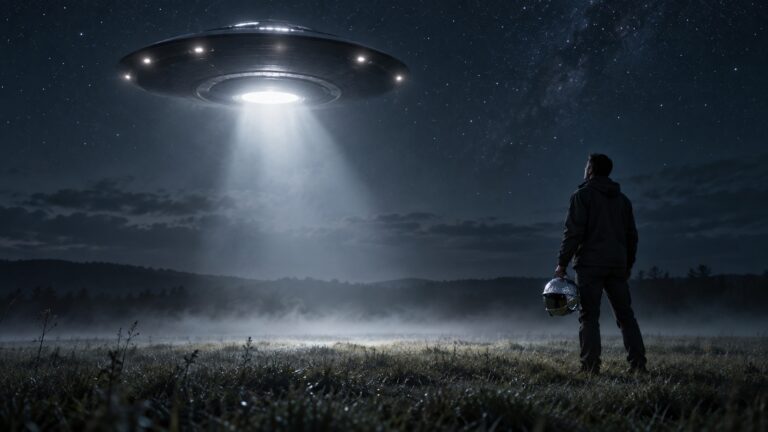
It hung in the air above a clearing. Not on the ground — in the air, off the ground, holding still against nothing, at about the height of the treetops and a little below. It was smooth and rounded, and the men would each reach for the same clumsy comparison afterward without having conferred on it: two pans set lip to lip, a dome riding the top. The gold came off it in broad uniform bands, panels of light with strips of a duller silver running between them, and the light was not warm the way firelight is warm. It was clean. It was the wrong kind of light to find in a forest at night, and it lit the clearing and the near trees in a color that belonged to no hour of the day.
The shadows were the worst of it. Every trunk between the truck and the object threw its shadow toward the men, long black spokes laid out across the ground and across the road, all of them pointing back at the cab, and the shadows didn’t move because the light didn’t move. It made the whole clearing look staged. Painted. A photograph of a place rather than the place itself.
Inside the truck the light found their faces. It came through the windshield and lay on them flat and gold, and Travis, glancing sideways, saw the men he’d worked beside all day made strange by it — every face turned the same direction, every jaw slack, cheeks and foreheads washed in that even glow so that they looked less like themselves than like carvings of themselves. Nobody was blinking much. Eyes reflected the thing back, small bright coins of it, six sets of them.
And there was no sound.
That was the part the mind kept snagging on. The engine idled under them, and the heater ticked, and outside all of that there should have been something — a hum, a roar, the beat of rotors, the thin whine of anything that could hold itself up in the air like that. There was nothing. The object made no sound at all. It simply was, and its silence pressed in against the noise of the truck until the noise of the truck seemed thin and small and temporary, a little pocket of ordinary racket surrounded on all sides by a quiet that had weight to it.
“Okay,” Rogers said, low. Just the one word. It wasn’t clear what it was supposed to mean.
Somebody laughed, one short broken sound, the kind that isn’t laughter. Somebody else was leaning forward over the seatback to see better and then, without seeming to decide it, leaning slowly back.
They were still trying, all of them. Travis could feel the whole cab straining after an explanation, some ordinary thing it could be — a weather balloon caught in the trees, a searchlight, a helicopter with its engine somehow stilled, the reflection of something, anything with a name he could say out loud and put it back in the world of known things. He reached for it and it wasn’t there. None of the names fit. And when a name won’t come, the fear that rushes in behind the gap is worse than the thing itself, because it has no shape yet.
The object hung in its gold and its silence and gave them nothing. It didn’t advance. It didn’t retreat. It waited, or it did the thing that looked like waiting, and the men sat in the idling truck with the shadows pointing back at them and none of them, yet, reaching for the door.
III. The Six Feet
He had the door open before any of them understood he meant to.
There would be a lot of argument later about why. Travis himself never gave a clean answer that satisfied anyone, least of all the men who had shouted at his back. He would say only that something in him wanted a closer look before the thing was gone — that he had always been the one pulled toward the edge of a drop, the fast line, the dare — and that in the moment it had felt less like a choice than a current he stepped into. The cab’s dome light came on weak and yellow, drowned by the gold pouring in through the glass, and then he was out, and the cold took him.
It was a harder cold outside than the fogged warmth of the cab had let on. It went straight through his clothes and found the sweat still on him from the day’s work, and he felt his shoulders draw up against it. His breath went out in front of him and hung there, lit gold, and drifted apart. Behind him he heard the men’s voices, sharp and overlapping — Travis. Travis, get back in. Get back in the truck — and he heard the words and they didn’t reach the part of him that was walking.
His boots came down on the forest floor, and he was aware of every step in a way a man usually isn’t. The crunch of frost-stiff needles. The give of rotted deadfall under one heel. A dry branch that cracked too loud and made his heart lurch before he understood it was only wood, only his own weight. He crossed the ditch at the road’s edge and came up the far side into the clearing, and with every yard the truck got smaller behind him and the voices got thinner, until they were just a sound, and then a sound he was leaving.
The light changed as he came into it. From the road it had lain flat across everything; here, underneath it, it wrapped him. His own shadow spilled out ahead of him across the ground, long and black and sharp-edged, thrown by the object at his back — no, in front of him now — and he watched his shadow shorten step by step as he closed the distance, drawing back into his own boots as the thing that made it grew nearer.
Up close it was worse, because up close it stopped making sense in new ways. The gold panels that had looked smooth from the road he could now see were divided by those bands of dull silver, and there were no seams that a machine ought to have, no rivets, no scorching, no grime — nothing that spoke of it having been built, of hands and tools and time. It was too clean. It had the finished, sealed look of a thing that had never touched dirt. And it was big above him now, filling the sky where the treetops should have been, close enough that he could have crossed the last of the ground at a run and put his hand on the underside of it.
He stopped.
He was near enough now to feel that the silence around the object was not the ordinary silence of a forest at night. A forest is never truly quiet — there is wind in the high branches, there are small things moving in the litter, there is the sound your own body makes. All of that had gone. The world had drawn its breath and held it. He stood in that held breath, close enough to touch, and looked up at the smooth gold curve of it hanging over him, and he was aware of the truck a long way off at his back, and the men in it, and how far away they suddenly were, and how alone a man could be standing under a thing like this in the cold with no name for it.
Then the object moved.
Not away — not up. It came alive where it hung. A sound broke out of it all at once, a scramble of hard mechanical noise where a moment before there had been nothing, and the great gold shape began to wobble on its axis, tilting and correcting, tilting, a heavy thing suddenly unsteady in the air directly over his head. He felt the wrongness of it in his stomach before his legs got the message. He turned to go — he would say he’d only just started to turn —
and the light came.
It came off the underside of the object in a single stroke, blue-green and blinding, with a sound he would never afterward be able to describe as anything but a crack — a sharp, splitting pop, like the world’s largest static shock, like the air itself tearing. It caught him across the head and the chest. There was no interval in which he understood what was happening. There was the crack and the light and then a force went through him that he could only ever compare to a jolt of current, every muscle seizing at once, his whole body going rigid and useless in the same instant, and he was lifted — thrown — a sensation of flying backward with the ground gone out from under him and the cold air rushing past and the gold light wheeling overhead —
and then there was nothing, and it went on being nothing for a long time.
IV. The Ground Gives Way
Afterward, none of them could put the next few seconds in order.
They had seen Travis go up in the light. That much they agreed on — the blue-green flash and their friend lifted off his feet and flung back through the air like something the wind took, ten feet, more, and down. Then the beam was gone and so was the reason they’d been holding still. Rogers had the truck in gear before he knew his hand had moved. Somebody was already screaming at him to go. The truck lurched, stalled, caught again, and slewed off down the road with the back end fishtailing on the loose rock, and the men were thrown together in the cab, grabbing at the dash, the seatback, each other.
The voices ran over each other so no single one could be picked out.
He’s dead, that thing killed him —
Go, go, go —
It’s coming, is it coming —
Nobody looked back for the first stretch of it. That was the thing some of them would have trouble living with. They ran. The headlights bucked over the ruts and the trees tore past white and gone, and Rogers drove it too fast for that road, the truck slamming down hard enough on its springs to knock their teeth together, and behind them the gold light fell away among the trunks and every man in that cab was certain, with a certainty that came up out of the animal part of him, that the thing was rising up now to come after them.
It didn’t.
A quarter mile on — half a mile, they were never sure — the certainty wore thin enough for Rogers to ease off. He slowed. He stopped. The engine idled and their own breathing filled the cab, ragged, too loud. Out the back window the forest had closed up dark behind them. Whatever it was hadn’t followed. And in that stillness, with the panic draining out of them and leaving the cold behind, the thing they had done arrived all at once.
They had left him. Whatever had happened back there, Travis had gone down and they had driven away and left him lying in the dirt.
For a moment nobody said it. Then somebody did, and then somebody was crying, and one of the men had his hands over his face and another was arguing in a high cracked voice that Travis was dead, that he had to be, that nothing walked away from what they’d all just watched — as if being dead already could make the leaving alright. Rogers said they were going back. He said it more than once before it landed. There was pushback. There was a man who did not want to turn that truck around and said so, and there was no shame put on him for it in the moment, because every one of them felt the same pull the other way. But Rogers turned it around.
The drive back up was worse than the drive down. Slower. The headlights swung across the same trees and this time the men read something into every one of them. The forest had changed while they were gone — not in any way a person could point to, but changed, the way a room is changed after a bad thing has happened in it. They came up on the clearing braced for the gold light and there was no gold light. There was no object. There was the clearing, ordinary and black and cold, the shadows all fallen back to nothing.
And there was no Travis.
They got out and called for him. Their voices went out into the trees and came back flat. They walked the ground where he’d fallen, and there was nothing there to find — no body, no blood, no track, no sign a man had been thrown down in that dirt an hour before. Just the frost coming back onto the needles where their boots hadn’t broken it. Rogers, standing in the clearing, thought he caught it then — off through the trees, a streak of the gold going up and out and gone. He couldn’t be sure. He was never sure. He said it looked like a disc, going away.
They didn’t stay long. There was nothing to stay for. They loaded back into the truck and drove until they found a phone.
The Gap
The report goes out over the county line near midnight. Deputy Ellison first. Then the sheriff. Six men and a story no one knows what to do with, and one man gone.
The search started at first light and grew all day. Fifty and more, by the end — the Forest Service, the county’s search-and-rescue people, neighbors who’d heard and come out to walk the timber in a line. They covered the ground around Turkey Springs and found what you find in a forest: deadfall, animal sign, cold. No Travis. The men from the crew walked it too, all but the youngest, who couldn’t. He sat it out, still not right.
There was a man in a Forest Service uniform who moved through the search with a Geiger counter and wouldn’t be drawn into talk. Rogers watched him work it over the ground and get nothing but the ordinary background click. Then the man passed it near the crew’s hard hats and the needle jumped — four times over, Rogers would say. The man looked at them for a moment without a word. When they asked him to run it over the truck he didn’t. He walked off.
By the third day the ground under the men had shifted.
You could feel the mood turn. Fifty people don’t find a body because there is no body, and a story about a light in the trees only holds up so long against that silence. The word that started going around was not lost. It was hidden. Men from the town, and then the men’s own families, began to wonder aloud whether the six of them had done something to the seventh out there and dressed it up in something no one could check. They were pulled in and questioned, one after another, the same questions worked over from different sides. On the tenth day a polygraph examiner ran them through a machine. One man came apart under it badly enough to read nothing at all. The examiner passed the rest. He wrote that he believed them. It changed very little.
And under all of it — the searching, the questions, the suspicion hardening into something that could put men in prison — the plain fact of the days going by. One day. Two. Three. A man does not survive being lost in that country in November for long. Whatever was happening to the six of them, the seventh was, by every ordinary measure, running out of time or already out of it.
He’d been gone the better part of a week.
Then, near midnight on the fifth day, a phone rang at his sister’s house.
He was on a road outside Heber, face down on the cold asphalt, and the first thing he knew was pain — a burning that seemed to be laid over his whole body, and above him a light going off on the underside of something bright and smooth and low over the road, and then that something shot straight up and was gone without a sound and left him alone in the dark with no idea where he was or how long he had been anywhere.
He got himself to a phone booth. He called, and his voice frightened whoever answered, and his brother-in-law and his brother Duane drove out into the night to find him.
They found a man who thought he’d been gone a couple of hours.
He didn’t believe them when they told him. He kept not believing it. Five days. His eyes were red and stayed red. He’d dropped better than ten pounds off a frame that hadn’t had it to spare. He was cold through and couldn’t get warm, and he was afraid in a way that had no clear object, jumping at the ordinary dark of the roadside. When they got him somewhere warm and safe he couldn’t sleep.
And when they asked him where he’d been, he couldn’t tell them. Not because he wouldn’t. Because it wasn’t there to tell — a little over an hour of it, at most, and even that came in pieces, and the pieces were bad enough that his body would refuse to let him reach them cleanly for a long time to come. A light overhead. A table. Pain, and then not pain. Eyes. The rest of it — the four days and change that no clock of his had counted — was simply gone, sealed off, a blank the exact shape and weight of the time everyone else had lived through while he was somewhere no one could name.
That was the part that frightened them worst, in the end. Not the story he told. The story he couldn’t.
VII. The Table
There was nothing, and then there was pain, and the pain hauled him up out of the nothing like a hook.
His head. Then his chest. Then all of him at once, a raw all-over burn like he’d been laid out too long against something hot. He came up into it and his stomach came up with it — a swat of nausea so hard he thought he’d be sick right there on his back, and couldn’t, because his body wouldn’t do that either. His eyes opened onto a light and the light wouldn’t hold still. It broke in two and slid and came back and broke again. Everything had a wet smear over it. He blinked and the blinking hurt.
His mouth. God, his mouth — dry didn’t cover it, it was past dry, tacky and thick, his tongue stuck to the roof of it, and when he tried to swallow there was a click in his throat and nothing went down. He was cold. Whatever he was lying on was colder, hard and flat under his back, and there was a weight on his chest pressing down, something he couldn’t see over the swim in his eyes, and he told his hand to go up to it and his hand didn’t move. He told it again. Nothing. His arms lay there like they belonged to somebody else and the panic that came with that was worse for a second than the pain, that specific horror of a body that won’t answer, and he could feel a sound trying to come up out of him and it died in his chest.
Hospital. He grabbed the word like a rail. He’d been hurt — he could feel he was hurt — so somebody had brought him in and this was the light over a table and the weight was one of their machines doing something to him, and there were people here, he could see them at the edges now, shapes moving, and they had clothes on, a color, and it was — orange. Loose orange. He hung on to it. Orderlies wore all kinds of things. It fit. For one more second it fit.
Then it stopped fitting, and it stopped fitting in pieces.
The quiet. A hospital is never quiet — there’s a cart somewhere, a voice, a machine keeping time with somebody’s heart. Here there was nothing. Not a footstep, not a word, not the little hum a room gives off. Just the light and the cold and a silence so total it had a pressure to it, sitting on him along with the weight. And no smell. That got to him almost as bad as the quiet — no bleach, no alcohol, no sourness, nothing. Air with nothing in it. He’d never been anywhere that smelled of nothing.
And the room was wrong. He couldn’t say how at first, only that his eye kept sliding off of it — corners that didn’t sit right, light coming from no place and every place so that nothing threw a shadow, not the shapes near him, not his own arm when he finally got it to twitch. No window. No door he could find. He lay there and worked at the word hospital the way you work a tooth that’s coming loose and it thinned and thinned and then it was gone and there was nothing to put where it had been.
Something moved at the side of him.
Not fast. That was the thing. Nothing here moved fast. It came around into the edge of his sight and the first of it he got was the cloth — the orange, closer now, and wrong close up, seamless, no button on it, no fold where a button would be, nothing stitched, like it hadn’t been made so much as poured. Then, below the cloth, a hand. And the hand was what turned him cold in a new way, because the hand was too long and too thin and there was no color in it, no pink of blood under it, pale to the point of gray, and it came toward the weight on his chest with a slowness that was somehow the most frightening thing yet, deliberate, unhurried, like it had all the time there was and knew it.
It leaned in over him.
And the eyes came down into his and they were enormous. Too big. Dark all through, wet, no white to them anywhere, and they took up too much of a head that was too big for anything he could see under it, and behind them there was nothing. Nobody. He’d been looked at by animals before, out in the country, and there was more in the eye of a deer than in this. It was looking at him and there was no one doing the looking.
His arm came up.
He didn’t decide it. The block that had held his body let go all at once and his body used the gift of it to strike, his hand shooting up and catching the thing across the front and shoving, hard, everything he had, and it went back into another one behind it that he hadn’t even clocked was there — and in the half-second his hand was on it, he felt it. He would spend years trying not to feel it again. It wasn’t a body. There was no muscle, no give of a person, nothing solid under the cloth — it gave all the way in, soft, sunk under his hand like pushing into something that had gone off, and his hand came away wanting to be cut off at the wrist, and the feel of it ran up his arm and he gagged, standing there, actually gagged on it.
He got off the table. His legs came down and buckled and dumped him half to the floor and he caught the edge and hauled himself up on it, sick, swaying, weak as water. He was furious. That was in there too, tangled up with the fear and worse for being tangled — furious that his legs wouldn’t hold, furious at the shake in his hands, ashamed of the noise he could hear himself making, some high scared sound he couldn’t stop, a grown man cornered and mewling, and he hated it, and he couldn’t quit it. He backed off the table and his spine hit a low run of surfaces along the wall with things laid out on them, small and pale, and he didn’t dare look down at them.
They didn’t come at him.
He almost wanted them to. They spread out instead, slow, easing across the room to close it down around him, stepping wide to cut off the space, silent the whole time, no sound off their feet, no breath he could hear, nothing on them he could read to know what came next. He couldn’t tell what they wanted. Couldn’t tell what they’d do. There were three of them now — he got that much, three — and they moved together without a look passing between them, like one thing in three places, and that was worse than if they’d charged him screaming, because a thing that charges you at least wants something you understand.
His hand went back over the surface behind him, blind, feeling, and closed on something and dragged it up in front of him. A tube. Clear, heavy-looking like thick glass, a foot and a half of it. The instant it was in his fist he knew it was junk — light, nothing to it, no weight to drive a blow. He turned and cracked the end of it down on the table to snap it, to break a point onto it, give himself an edge, and it didn’t break. He hit it again, harder, jarring his arm, and it held, whole and clear and useless, and he kept it anyway, because it was the only thing in the world his hand had found.
His body dropped into a fighting stance and there was nothing in it worth admiring. Weight down, feet spread, the tube stuck out ahead of him in a fist that would not stop shaking — his training coming up out of him without being asked, taking his body into a shape it knew, and it wasn’t courage, it was the opposite of courage, it was a man with nothing left grabbing at the one trick his hands had ever learned. He came up into it sweating and gray and swallowing bile, backed into the wall with nothing behind him, and he started shouting. He didn’t know what. Get back. Get away. Filth, curses, whatever came up his throat, his voice cracking on it, and he slashed the tube through the air in front of him, side to side, cutting the space to keep them off of him.
It half worked. They stopped closing. But they didn’t flinch — not a twitch, not a flinch, nothing living moves and never flinches — and they slid themselves between him and the only way out and stood there, and watched, and the watching had no more feeling in it than the eyes had, and he’d have given anything for one of them to blink.
He couldn’t stop looking at them. Hated it and couldn’t stop, because you keep your eyes on what might get you. He took them in a piece at a time and none of the pieces got easier. The skin — pale past pale, a soft dead white with something almost see-through under it, more like fat than like anything living. The heads too big, riding those small slight bodies, none of them up to his shoulder. The eyes, always dragging him back to the eyes, huge and dark and flat, empty of everything a face is supposed to have.
And he knew, standing there swinging glass at them, that touching one had been worse than looking at all three, and that if they got their hands on him he did not think he could stand it — not the pain of it, the feel of it, that soft giving nothing under his skin again. That was the whole of his thinking now. Don’t let them touch you. Get past them and don’t get touched. He was trying to work out how, and there was no how, when the three of them turned at once — together, no sign between them — and went. Fast, this time. Out the doorway and gone down some hall, and the room was empty and he was alone in it with his heart going like a fist on a door and the tube still up in his hand.
He didn’t waste it. He went along the surfaces fast, looking for something with weight, something real, something he could hurt with — and there was nothing. Small pale things, none of them a weapon, every one of them too light or too strange to trust his life to. He threw the tube down. He checked the doorway. When they didn’t come back through it he went out the way they’d gone, into a hall that curved so he couldn’t see ahead, the wall bending off and taking the view with it, and he went along it braced sick and shaking for them to be around the bend.
The hall opened into another room, and there was one chair in it, alone, in the middle. He went for it and as he got close the walls weren’t there — not opened, not slid away, just gone — and the floor with them, and all around him and under him was a black depth with points of light strewn through it, going on and on with no bottom and no wall to it, and it told him flat and cold what the beings had already told him: there was nowhere here. No ground under this. Nowhere to run even if he ran. He sat in the chair because his legs were done arguing. There were things on the arms of it he could work and he worked them and nothing he did did anything at all.
Then a sound at the door, and he came around, and it was a man.
A person. Human — tall, bigger than him, six foot and change, put together solid — standing in the doorway in a suit that fit close and a helmet, an ordinary human shape after all of it, and the relief that hit him nearly folded him back onto the floor. He got up. It came pouring out of him, all at once — where was he, how did he get out, what was happening, what were those things — every question tripping the next one at the first human face since the light took him.
The man said nothing.
Stood there. Let him talk. Gave back not one word. And in the silence where the answer should have gone, the relief began to turn in his stomach. The man was too still. He stood easy in that doorway like none of it reached him at all, calm the whole way through, calm the way nothing in that place had any business being — a man watching weather through glass while another man stood in front of him coming apart. The eyes, what showed of them, were a strange gold, and there was something in them, or gone out of them, that Travis could never afterward put into any words that held it — not the way a person’s eyes are when a scared man is right in front of them asking to be told something.
He kept telling himself it was the helmet. That was why there was no answer — the helmet over the mouth, that was all it was, that was the whole reason. He wanted it to be that. He needed the man to be a man.
The figure reached out and took him by the arm. Not rough. Nothing hard in it — the grip was calm, near gentle, the way you steady somebody who might go down. And Travis let it. He went. He told himself he was being helped, that this was the end of it, that a calm hand meant a kind one — and he walked where the tall silent man led him and didn’t fight it, because behind him was the room with no floor and the soft pale things somewhere in the halls, and a steady warm grip on his arm was the only thing in any direction that felt like it might be mercy.
He went. And he could not have told you then, and can’t tell you now, whether the hand was leading him out or leading him deeper — whether it was the first kind thing anyone had done to him in that place, or only the next thing to get hold of him.
About the Author