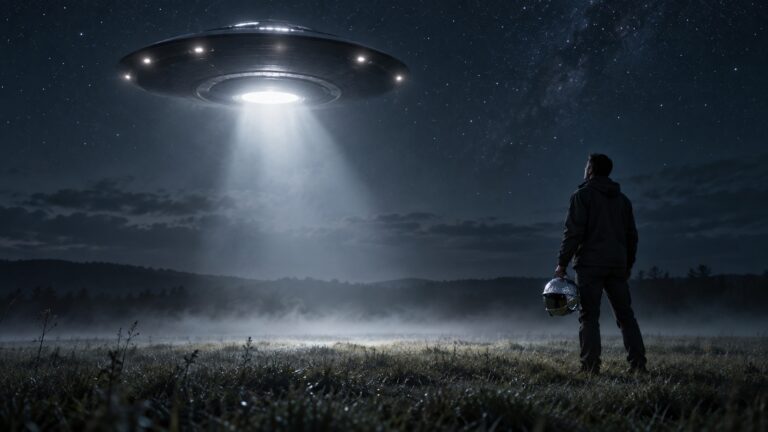
You might find it intriguing to explore the life of James E. McDonald, a meteorologist who took a bold stance against the widely accepted Condon Report on UFOs. His rigorous approach to investigating unexplained aerial phenomena raises important questions about the boundaries of scientific inquiry. What drove McDonald to challenge the status quo? As you uncover his journey, you may discover compelling insights that still resonate in today’s discussions about the unknown.
Early Life and Education
James E. McDonald grew up in a world teeming with curiosity and wonder. You can imagine him as a young boy, enthralled by the mysteries of the sky, which would later shape his future pursuits.
Earning a bachelor’s degree in meteorology from the University of Arizona, he laid the groundwork for his career. His education didn’t stop there; he went on to obtain a Ph.D. in physics from the same institution.
This strong academic background not only fueled his interest in atmospheric sciences but also ignited his fascination with UFO phenomena. You might consider how his early experiences and education enabled him to challenge conventional beliefs, setting the stage for a life dedicated to unveiling the unknown.
Career in Meteorology
Although many pursue careers in meteorology, few blend scientific inquiry with the mysteries of the unknown like McDonald did. His work as a meteorologist wasn’t just about predicting weather patterns; it involved a deep fascination with atmospheric phenomena, including UFO sightings.
You might find it intriguing that McDonald viewed weather not just as a science but as a gateway to understanding unexplained events in our skies. He used his expertise to analyze and question reports, often challenging conventional wisdom.
The Condon Report Explained
When examining the Condon Report, you’ll quickly realize it represents a pivotal moment in the study of UFOs during the 1960s.
Commissioned by the U.S. Air Force, this extensive investigation, led by physicist Edward Condon, aimed to assess the validity of UFO claims. The report concluded that UFOs posed no threat to national security and that further scientific study was unwarranted.
While it attempted to provide a rigorous examination of sightings, many believed its findings were overly dismissive. You might wonder how such a definitive conclusion could emerge from a field still shrouded in mystery.
This report’s impact on public perception and scientific inquiry into UFOs continues to spark debate, influencing both skeptics and enthusiasts alike.
McDonald’s Critique of the Condon Report
Critics of the Condon Report, like physicist James E. McDonald, raised significant concerns about its conclusions.
You’ll find that McDonald argued the report lacked thorough investigation and dismissed credible UFO sightings without proper analysis. He believed it ignored a wealth of evidence, undermining the report’s credibility.
McDonald emphasized the importance of open-mindedness in scientific inquiry and felt the report’s findings reflected a bias against UFO research. He urged for a more rigorous examination of the evidence, advocating for transparency and accountability in evaluating unexplained phenomena.
Notable UFO Sightings Investigated by McDonald
James E. McDonald investigated several notable UFO sightings, each challenging the status quo. One significant case involved a 1957 encounter by a group of Air Force pilots in Arizona. They reported a bright, fast-moving object darting across the sky, baffling their radar systems.
You can imagine McDonald’s excitement as he meticulously analyzed witness testimonies and radar data, seeking scientific explanations.
Another intriguing sighting occurred in 1965 when a couple in Michigan observed a disc-shaped craft hovering above their home.
McDonald’s determination to uncover the truth led him to interview the witnesses personally, gathering insights that mainstream science often overlooked. His relentless pursuit of evidence reflects a broader quest for understanding, urging you to consider the mysteries beyond our skies.
Advocacy for Scientific Inquiry Into UFOS
Although skepticism surrounds the topic of UFOs, McDonald fervently advocated for rigorous scientific inquiry into these phenomena.
He believed that dismissing UFO sightings without thorough investigation stifled scientific progress and undermined our understanding of the universe.
McDonald argued that, as rational beings, you should seek the truth behind these unexplained occurrences rather than accept convenient explanations.
He encouraged scientists to approach UFO reports with an open mind, emphasizing that genuine curiosity could lead to groundbreaking discoveries.
By challenging the status quo, he aimed to inspire a movement that prioritized empirical study over ridicule.
Ultimately, McDonald’s passion for inquiry invites you to consider the possibilities beyond our current knowledge, urging a more profound exploration of the unknown.
Impact on the Scientific Community
The push for rigorous scientific inquiry into UFOs, championed by McDonald, significantly influenced the scientific community’s approach to unexplained phenomena.
His insistence on scrutinizing credible sightings prompted scientists to reevaluate their skepticism. They began to explore these phenomena with an open mind, recognizing that dismissing them outright could stifle potential breakthroughs.
McDonald’s work encouraged interdisciplinary collaboration, drawing in experts from various fields like physics, psychology, and engineering to investigate UFO reports scientifically.
This shift fostered a more inclusive dialogue within academia, urging researchers to consider unconventional data.
As more scientists embraced this inquiry, it became clear that the pursuit of knowledge shouldn’t be limited by conventional boundaries, allowing for a richer understanding of the universe and our place within it.
Legacy and Recognition
While many may not recognize his name, McDonald’s contributions to the study of UFOs left an indelible mark on both scientific inquiry and public discourse.
You can see his legacy in the way he challenged the status quo, urging scientists to examine the unexplained with open minds. His passionate advocacy for rigorous investigation inspired a generation of researchers and enthusiasts alike.
By emphasizing the need for transparency and critical thinking, he paved the way for more serious discussions about unidentified aerial phenomena. Even today, his work resonates, encouraging individuals to question accepted narratives and seek the truth.
McDonald’s courage in confronting skepticism remains a beacon for those striving for enlightenment in a world often shrouded in mystery.
Continuing Relevance of McDonald’s Work
As you delve into the continuing relevance of James E. McDonald’s work, you’ll find his insights resonate more than ever.
His rigorous approach to investigating UFOs challenges you to think critically about unexplained phenomena. In today’s age of misinformation, McDonald’s emphasis on scientific inquiry and open-mindedness serves as a beacon for those seeking truth.
You might wonder how his methods could apply to modern investigations, particularly with the advent of new technologies and data analysis techniques. The ongoing debates about UFOs, coupled with recent government disclosures, underscore his legacy.
Embracing McDonald’s spirit of inquiry empowers you to explore the unknown, fostering a deeper understanding of both our universe and the potential realities that lie beyond our current knowledge.
About the Author