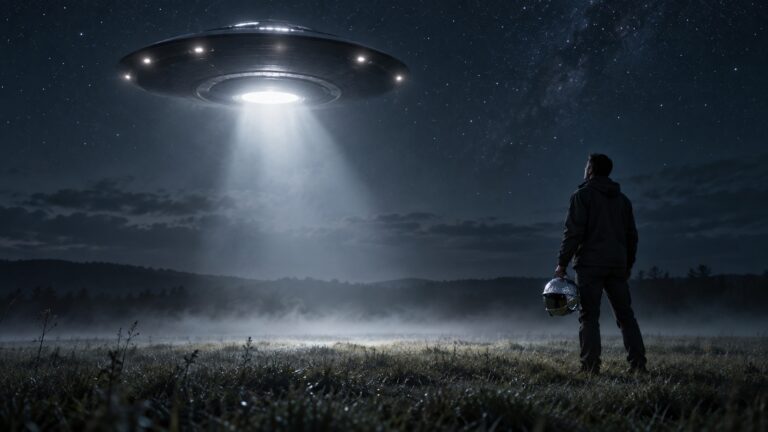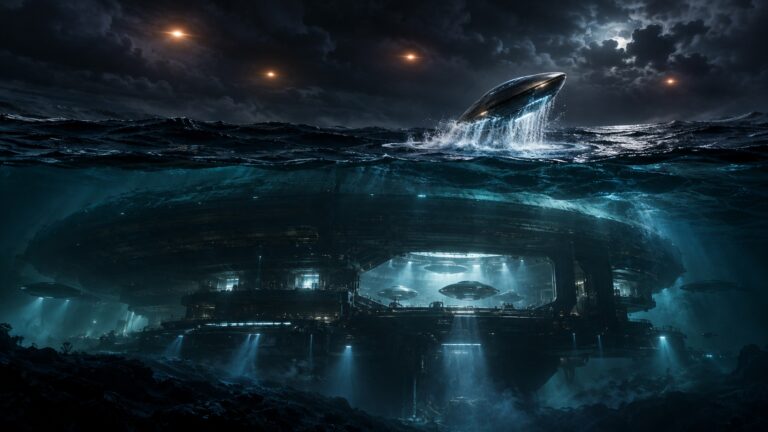
Imagine a world where UFOs aren’t just extraterrestrial visitors but perhaps beings from alternate dimensions. Jacques Vallée, a pioneering computer scientist, proposes this intriguing idea through his interdimensional hypothesis. His work merges technology with the mysteries of the universe, challenging what you think you know. What if the unexplained phenomena you’ve heard about are just the tip of a much deeper reality? The implications are vast, and they invite more questions than they answer.
Early Life and Education
Jacques Vallée, born in 1939, grew up in a world buzzing with curiosity about the unknown. In his early years, you can imagine him wandering through the streets of Puy-de-Dôme, France, captivated by tales of UFOs and otherworldly phenomena.
His inquisitive spirit led him to explore the realms of science, philosophy, and spirituality. As he pursued his education, he absorbed the ideas of pioneers like Carl Jung and Albert Einstein, igniting a passion for understanding consciousness and reality.
This foundation shaped his future inquiries into phenomena that challenged conventional thinking. You might see how these experiences fueled his quest for freedom from societal norms, encouraging him to embrace the mysterious and the unexplained, ultimately guiding him toward groundbreaking theories.
Career in Computer Science
During the late 1960s, Vallée made a significant transition into the world of computer science, where his innovative thinking began to shine. You’d see him explore the potential of computers in ways that challenged conventional wisdom.
Vallée developed groundbreaking algorithms for data processing, which laid the groundwork for modern network systems. His work at the Stanford Research Institute didn’t just contribute to technology; it sparked a revolution in how you’d think about information sharing and communication.
Imagine the excitement as he bridged the gap between human intuition and machine efficiency. Vallée’s unique perspective on technology reflected his belief in freedom and exploration, encouraging you to question the status quo while embracing the endless possibilities of the digital age.
The Interdimensional Hypothesis Explained
Vallée’s work in computer science laid a foundation for questioning our understanding of reality, leading him to the intriguing concept of the Interdimensional Hypothesis.
This idea suggests that UFOs and other unexplained phenomena might originate from dimensions beyond our perception. Instead of viewing these occurrences as mere extraterrestrial visits, you can explore the possibility of them being interdimensional interactions.
Imagine beings or entities from alternate realities influencing our own, challenging your notions of space and time. With this hypothesis, you’re invited to expand your mind and consider a universe teeming with layers of existence, where encounters could transcend the physical realm.
It opens pathways for understanding the unknown, urging you to ponder the limitless nature of reality itself.
Key Publications and Research Contributions
As you delve into the key publications and research contributions of Jacques Vallée, you’ll uncover a tapestry of ideas that challenge conventional thinking about UFOs and consciousness.
His seminal work, “Passport to Magonia,” proposes that UFO phenomena might be linked to ancient folklore, suggesting a deeper, interdimensional reality.
In “Dimensions,” Vallée explores the implications of alternate realities, urging readers to rethink the nature of existence itself.
He also contributed to the scientific community with rigorous data analysis, advocating for a multidisciplinary approach to studying unexplained aerial phenomena.
Each publication invites you to question the boundaries of perception, encouraging a quest for knowledge that transcends traditional paradigms.
Vallée’s insights inspire a liberating curiosity about the universe’s mysteries.
Vallée’s Influence on UFO Studies
The ripple effect of Jacques Vallée’s work on UFO studies is profound, reshaping how researchers and enthusiasts approach the phenomenon.
His interdimensional hypothesis challenges conventional thinking, inviting you to explore beyond the mere physicality of UFOs. Vallée encourages you to consider the psychological and cultural dimensions of encounters, suggesting they might reflect deeper truths about human consciousness.
By blending science with the enigmatic, he empowers you to question accepted narratives and seek your own understanding of these mysteries.
His influence inspires a new generation of thinkers, pushing boundaries and fostering an environment where imaginative exploration thrives.
Vallée’s legacy invites you to embrace curiosity, urging you to delve into the unknown with an open mind and a spirit of inquiry.
Critiques and Controversies
While many embrace Jacques Vallée’s interdimensional hypothesis as a groundbreaking perspective in UFO studies, others raise pointed critiques that spark intense debate.
Critics argue that Vallée’s theories lack empirical evidence, questioning whether the interdimensional framework can truly account for the myriad of UFO phenomena reported worldwide.
Some skeptics believe his approach strays too far into the metaphysical, risking dismissal from mainstream scientific discourse.
You might find discussions centering on whether his hypothesis oversimplifies the complexities of human perception and experience.
Additionally, detractors warn that focusing on interdimensionality could distract from more tangible, terrestrial explanations for UFO sightings.
Engaging with these critiques invites you to consider the broader implications of Vallée’s work and challenges you to think critically about the nature of reality itself.
The Intersection of Technology and Mysticism
Vallée’s interdimensional hypothesis opens intriguing possibilities at the crossroads of technology and mysticism. Imagine the potential when advanced technology meets ancient spiritual practices. You might find that cutting-edge tools, like artificial intelligence, could help decipher the hidden meanings of mystical experiences.
What if these experiences aren’t just hallucinations but glimpses into alternate dimensions?
As you explore this intersection, consider how meditation and consciousness research align with quantum mechanics and information theory. Could our understanding of the universe expand when we embrace both empirical data and spiritual insight?
This fusion invites you to question the nature of reality itself, blending the analytical with the intuitive. The journey invites curiosity and freedom, urging you to explore uncharted territories of thought and existence.
Implications for Understanding Reality
As you delve into the implications of Vallée’s interdimensional hypothesis, you might start to see reality in a radically different light.
What if the experiences we label as paranormal or extraterrestrial are merely glimpses into dimensions beyond our perception? This perspective invites you to question the rigid boundaries of reality, suggesting that consciousness itself could be intertwined with these other realms.
You’ll find yourself considering the possibility that our understanding of physics, time, and space is just the tip of the iceberg. Embracing this interdimensional view can liberate you from conventional thinking, encouraging exploration of your consciousness and the universe’s mysteries.
Ultimately, it opens a path to a deeper connection with existence, freeing you from the limitations of a solely material worldview.
Legacy and Future Directions in Research
Even if the interdimensional hypothesis remains controversial, its influence on the study of consciousness and unexplained phenomena is undeniable. Vallée’s work challenges you to think beyond traditional boundaries, encouraging exploration of realities that coexist with our own.
As researchers delve deeper into consciousness and reality’s fabric, they may uncover truths that reshape our understanding of existence. Future studies could harness technology like virtual reality and neuroscience to explore these dimensions, inviting you to experience the unknown firsthand.
About the Author